- Plastic Surgery
Inverted nipple: What it is, why it happens, and how to correct it
- July 26, 2025
- By Fernando Amato
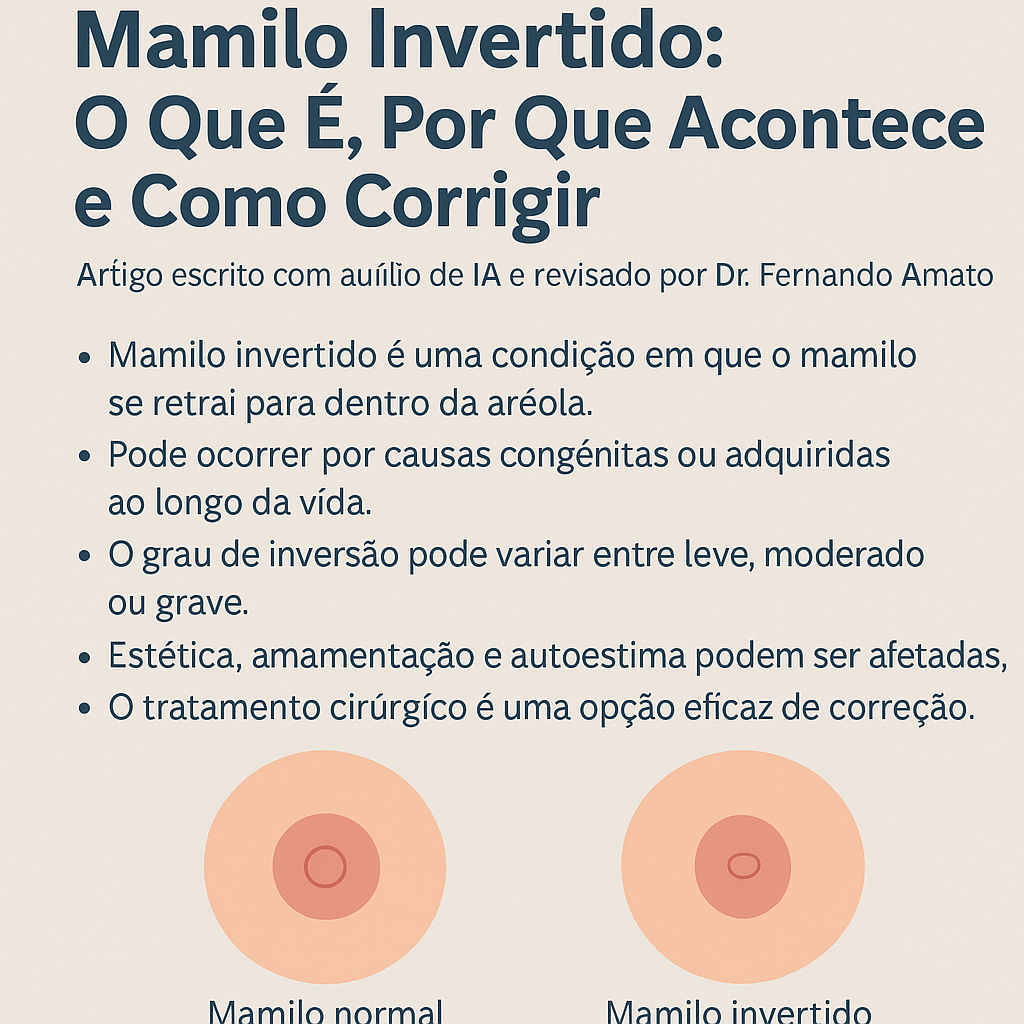
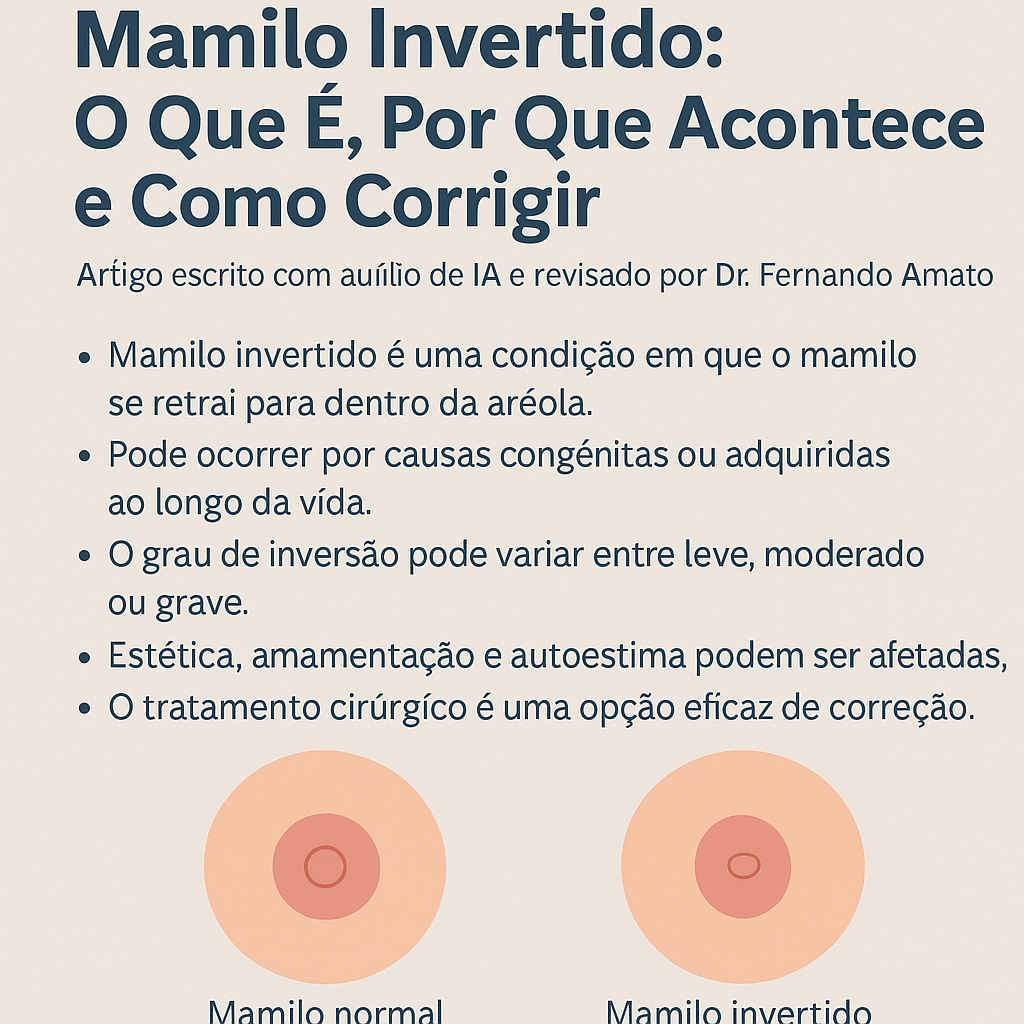
Inverted nipple, what could it be? Discover why some nipples point inwards and how surgery can restore aesthetics and function.
Article written with AI assistance and reviewed by Dr. Fernando Amato
What is an inverted nipple?
An inverted nipple is a condition in which the nipple, instead of projecting outward from the areola, is retracted or “pulled inward.” It can thus affect one or both breasts and range from mild to severe. Although usually benign, it can cause emotional discomfort, difficulties with breastfeeding, and in rare cases, indicate pathological changes.
🔍 Highlights
- 👩⚕️ Inverted nipples are common and often congenital
- 🍼 Can thus make breastfeeding difficult or impossible
- 🔬 Classified into three degrees of severity
- 🛠 There are non-surgical and surgical treatments
- 🏥 Surgery is simple, safe, and performed with local anesthesia
What are the causes of an inverted nipple?
The causes can however be congenital (present from birth) or acquired:
Congenital causes
- Incomplete development of lactiferous ducts
- Local fibrosis, preventing nipple projection
Acquired causes
- Post-surgical scars
- Mastitis (breast inflammation)
- Breast cancer (when accompanied by discharge or abrupt changes)
In these cases, however, it is essential to perform a clinical evaluation and examinations, such as mammography or ultrasound.
Types and degrees of inverted nipple
1 – Grade I (mild)
- Can evert spontaneously
- No duct compromise
2 – Grade II (moderate)
- Everts with manipulation but quickly retracts inward
- Some fibrosis and duct retraction
3 – Grade III (severe)
- Does not evert even with stimulation
- Ducts are shortened or fibrotic
Does an inverted nipple hinder breastfeeding?
Yes. In moderate and severe cases, breastfeeding can be compromised, as the baby has difficulty latching correctly onto the nipple. In severe cases, it may then be necessary to use nipple shields or surgical correction.
Inverted nipple correction: what are the options?
Non-surgical treatments
- Nipple shields
- Suction cups
- Manual exercises (Hoffman method)
These techniques are mainly effective for mild cases.
Surgery for inverted nipple
It is the most effective option, especially in Grade II and III cases.
How is it performed?
- Performed with local anesthesia
- Discrete incisions at the base of the nipple
- Release of fibrotic ducts
- Thus, in some cases, the ducts are preserved to allow breastfeeding
Recovery:
- Return to light activities in 1 to 2 days
- Use of protective dressings
- Visible results after a few weeks
When to seek a plastic surgeon?
- If the nipple causes aesthetic discomfort
- There is a history of infection or discharge
- Breastfeeding is impaired
Therefore, evaluation by a plastic surgeon is essential to determine the grade and the best approach.
Useful links to complement your reading:
Conclusion
Inverted nipple is therefore a common condition that can affect self-esteem and mammary function. However, fortunately, there are effective and safe solutions. Schedule an evaluation with a plastic surgeon to understand the best treatment for your case.
FAQ
- Is an inverted nipple normal?
Yes, it is relatively common and often congenital. - Can an inverted nipple turn into cancer?
No, not in isolation, but abrupt changes should be investigated. - Is the surgery safe?
Yes, it is a simple procedure with local anesthesia and low risk. - Can I breastfeed after surgery?
It depends on the technique. There are methods that preserve the lactiferous ducts. - How long does recovery take?
1 to 2 days for light activities. Final result in a few weeks. - Does surgery leave a scar?
The incisions are small and discrete, with almost imperceptible scars. - Do health plans cover the surgery?
Only when there is documented functional impairment. - Is it possible to correct an inverted nipple without surgery?
In mild cases, yes. Moderate to severe cases require surgery. - Can men also have inverted nipples?
Yes, and the treatment is similar to that for women. - Can it be done with other surgery?
Yes, it can be combined with mastopexy or breast implant placement.
Related articles



Agendar consulta
Precisa de orientação personalizada?
Marque uma avaliação com o Dr. Fernando Amato e tire as suas dúvidas sobre cirurgia plástica.
Falar no WhatsApp