
- Plastic Surgery
The Invisible Bottleneck of Breast Reconstruction in SUS
- April 25, 2026
- By Fernando Amato
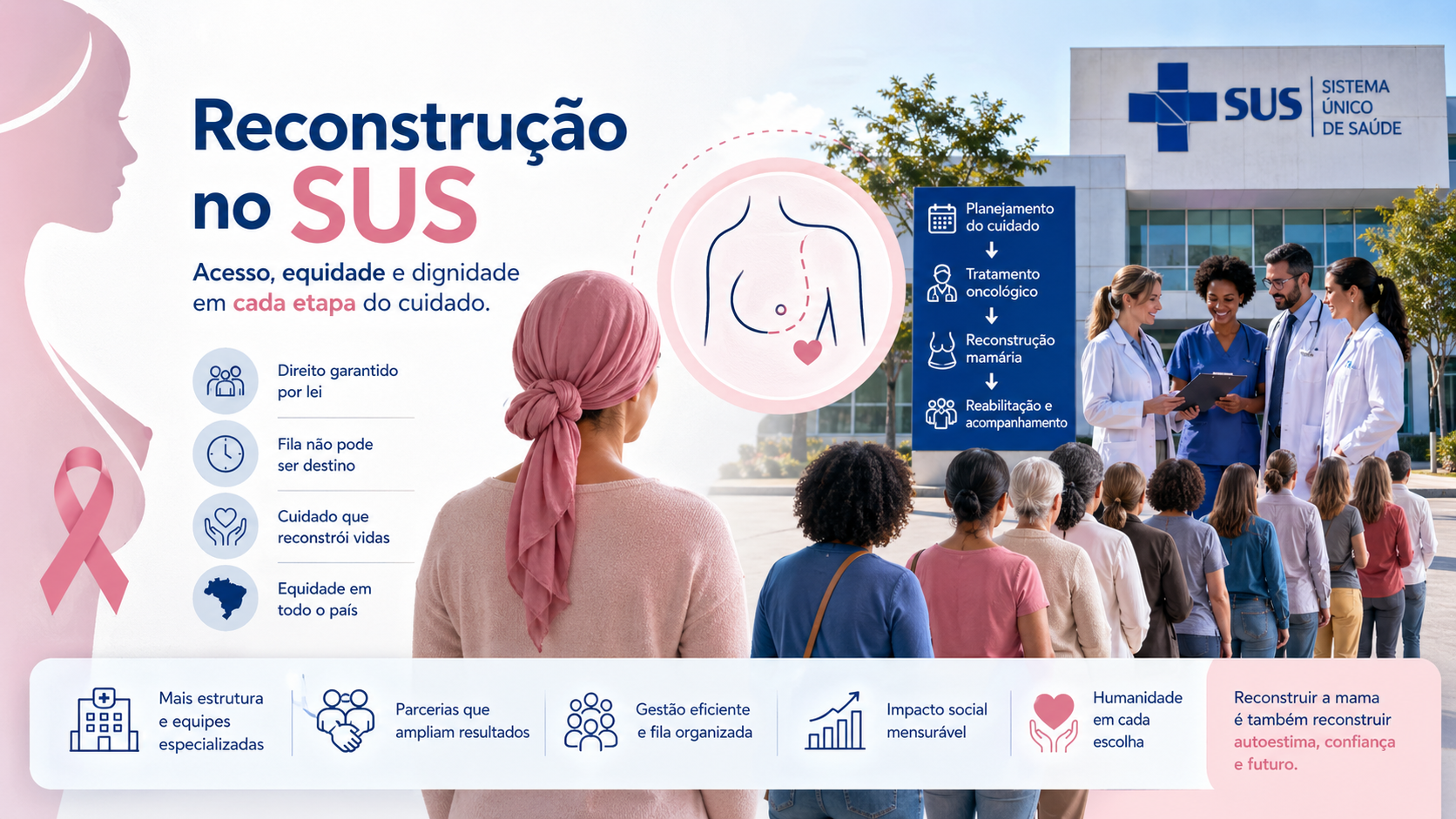
Breast reconstruction in the SUS (Brazil's public health system) exposes a significant contradiction in oncological care in Brazil. For years, the country has recognized that this surgery is part of the comprehensive care for women undergoing mastectomy. Nonetheless, actual access remains unequal, slow, and frequently interrupted by organizational barriers that are not very visible in public debate.
When breast cancer is discussed, attention usually focuses on diagnosis, oncological surgery, chemotherapy, and radiotherapy. Reconstruction, however, is often pushed to later, as if it were a secondary stage.
This scenario is even more significant because breast cancer remains one of the main challenges in women's health. For the 2026-2028 triennium, INCA estimates 78,610 new cases per year in Brazil. This shows that the demand for breast reconstruction is not occasional. It is a continuous, predictable, and structural need.
Breast Reconstruction in SUS is Not an Aesthetic Detail
Treating breast reconstruction as an accessory is a mistake. It is not just about appearance. It is related to physical rehabilitation, body image, self-esteem, and quality of life after breast cancer treatment.
Fiocruz itself emphasizes that care must be interdisciplinary and aimed not only at cure but also at quality of life. This includes informing the patient about their right to reconstruction.
In practice, a woman's journey does not end with mastectomy. When reconstruction is indefinitely postponed, the system sends the message that survival is enough. But surviving is not the same as rehabilitating. A mature oncological policy needs to encompass both dimensions.
The Right Exists, but Access Continues to Fail
Brazil has advanced on the legal front. Law No. 12,802/2013 determined that, where clinically feasible, breast reconstruction should be performed during the same surgical procedure as the mastectomy. If this is not possible, the subsequent procedure must also be guaranteed.
In 2018, Law No. 13,770 reinforced this right in cases of mutilation resulting from cancer treatment. In 2025, Law No. 15,171 extended the right to reconstructive breast surgery for cases of total or partial mutilation, regardless of the cause.
The problem is that the law alone does not create trained teams, surgical rooms, regulated flow, or integration between services. This is the core of the invisible bottleneck. The challenge is not just in recognizing the right, but in the system's capacity to deliver this care at scale.
The Extent of Assistential Delay
Available data show a persistent gap between need and supply. In 2023, the Ministry of Health reported that over 20,000 women were awaiting breast reconstruction in the public network and announced an investment of over R$100 million to expand access.
Even so, the most recent signs indicate that the structural deficit remains. In 2024, a report echoed by Oncoguia pointed out that only 25% to 30% of women who undergo mastectomy are able to have reconstruction through SUS. The same material cites about 10,000 breast reconstructions performed in 2021, compared to approximately 23,000 annual mastectomies.
In April 2026, the Brazilian Society of Mastology again warned that only 20% of SUS patients have access to reconstruction after mastectomy. Percentages vary depending on the analyzed base, but the direction is the same: under-access remains significant.
Additionally, a journalistic survey with Ministry of Health data showed, in March 2025, that reconstructive surgery was among the procedures with the longest average waiting time in SUS, potentially approaching two years in some scenarios. Even when the queue does not formally appear as “breast reconstruction,” this environment of delay helps explain why so many women face a second battle after oncological treatment.
Why the Queue Moves Slowly
The delay cannot be explained solely by the lack of surgical vacancies. This is an important factor, but not the only one.
Many patients do not even enter a clear reconstruction pathway at the time of oncological planning. When mastology, clinical oncology, radiotherapy, plastic surgery, physiotherapy, and regulation work in a fragmented manner, reconstruction becomes treated as a later stage, without a deadline, without a well-defined priority, and without coordination throughout the journey.
There is also a strong concentration of specialized teams in few centers. This increases regional inequality, increases the need for displacement, and reduces predictability for the patient.
Another problem is the competition for space in the operating room. When there is no protected schedule, dedicated operating block, or specific targets for breast reconstruction, cases tend to be repeatedly postponed.
Furthermore, patients are not all the same from a technical point of view. Some can have immediate reconstruction. Others need staged reconstruction. There are also more complex cases, requiring expanders, flaps, or lipofilling. Without organization by degree of complexity, the system mixes different profiles in the same queue and loses efficiency.
Equity is Not Offering the Same to Everyone
Talking about equity is more than saying that the law applies throughout the country. Equity means recognizing that access conditions are unequal from the start.
A woman treated in a center with structured mastology, reconstructive plastic surgery, and integrated radiotherapy has a more concrete chance of timely reconstruction. Another, in a region with lower care density, may finish oncological treatment without even entering a consistent rehabilitation pathway.
Therefore, expanding access does not depend only on opening vacancies. It requires care models capable of reducing variability between territories, standardizing criteria, organizing regional references, and monitoring indicators across the entire care line.
Scalable Care Models: Where SUS Can Advance
Breast reconstruction in SUS needs to move from an improvised logic to a care pathway logic with installed capacity.
A first step is to incorporate reconstruction into oncological planning from the outset. Whenever clinically feasible, the discussion about immediate reconstruction should occur within the same therapeutic decision-making flow. This reduces missed opportunities and avoids creating a second queue.
Another path is to regionalize more intelligently. Not every hospital needs to perform all types of reconstruction, but the network can define reference centers according to the degree of complexity, with clear referral and return protocols.
It is also important to work with protected surgical schedules and specific care targets. When breast reconstruction is only included in the general set of reconstructive surgeries, it tends to lose operational priority. Monitored production, transparent queues, and public indicators help provide predictability.
Training and multiprofessional integration are also crucial. Breast reconstruction does not depend solely on the plastic surgeon. It involves mastology, nursing, physiotherapy, psychology, anesthesia, regulation, and primary care.
Finally, it is worth considering hybrid models, with qualified task forces and social projects articulated with the public network. Initiatives like Mama Minha and IRMAMAS draw attention because they do not only offer surgery. They show how screening, integrated teams, institutional partnership, and continuity of care can generate real impact.
From Surgery to Comprehensive Care
Breast reconstruction is not limited to the operative act. Functional rehabilitation, complication prevention, psychological support, guidance, and follow-up are also part of care.
This point is crucial because when care is organized only around the tumor, the woman may leave treated from an oncological perspective, but still underserved in her global rehabilitation. Breast reconstruction needs to be understood as part of the continuum of care, and not as an optional complement.
What This Bottleneck Reveals
The wait for breast reconstruction reveals a greater challenge for SUS. It is not enough to guarantee access to life-saving treatment. It is also necessary to guarantee access to rehabilitative care.
Mature systems do not measure success only by tumor removal or protocol completion. They also measure their ability to restore function, autonomy, and dignity.
If breast reconstruction continues to be pushed to the end of the queue, it will remain invisible to management and painfully real for the patient. The challenge, therefore, is not just to increase numbers. It is to redesign flows, reduce inequalities, agree on responsibilities, and recognize that, in many cases, reconstructing the breast also means reconstructing life.
FAQ
Is breast reconstruction mandatory for every patient undergoing mastectomy?
No. Breast reconstruction is a right, not an obligation. The decision depends on clinical factors, oncological treatment, patient preferences, and the assessment of the care team.
Does reconstruction need to be performed at the same time as mastectomy?
Whenever appropriate clinical and oncological conditions exist, legislation provides for reconstruction to be performed in the same surgical act. When this is not possible, the procedure can be scheduled for later, without losing the right.
Why are so many women still waiting for reconstruction in SUS?
The delay usually results from a combination of several factors: lack of specialized teams, poor integration between services, limitations in operating theaters, regional inequality, and inefficient regulatory flows. In many places, the problem is more organizational than legal.
Is breast reconstruction solely an aesthetic issue?
No. Body appearance is part of the discussion, but it does not summarize the problem. Reconstruction is also linked to physical rehabilitation, body image, self-esteem, and quality of life after cancer treatment.
Do scalable models mean performing mass surgeries without individualization?
No. Scalability in health means organizing the network to serve more people with clear criteria, safety, and continuity of care. This includes reference centers, well-defined protocols, and appropriate follow-up.
Can social projects replace public policy?
No. They can alleviate queues, test organizational models, and produce replicable solutions. But the main responsibility remains with the public system.
Can every patient undergo the same type of reconstruction?
No. There are different techniques, such as immediate reconstruction, staged reconstruction, with expanders, implants, flaps, or fat grafting. The choice should be individualized according to the clinical condition, the treatment received, and the need for radiotherapy.
Recommended video: Breast Reconstruction: The Transforming Project “Mama Minha” — https://www.youtube.com/watch?v=M5bxjtTGbU4

Related articles


Agendar consulta
Precisa de orientação personalizada?
Marque uma avaliação com o Dr. Fernando Amato e tire as suas dúvidas sobre cirurgia plástica.
Falar no WhatsApp