- Plastic Surgery
Facial Fat Grafting: Natural Rejuvenation with Fat
- August 17, 2025
- By Fernando Amato
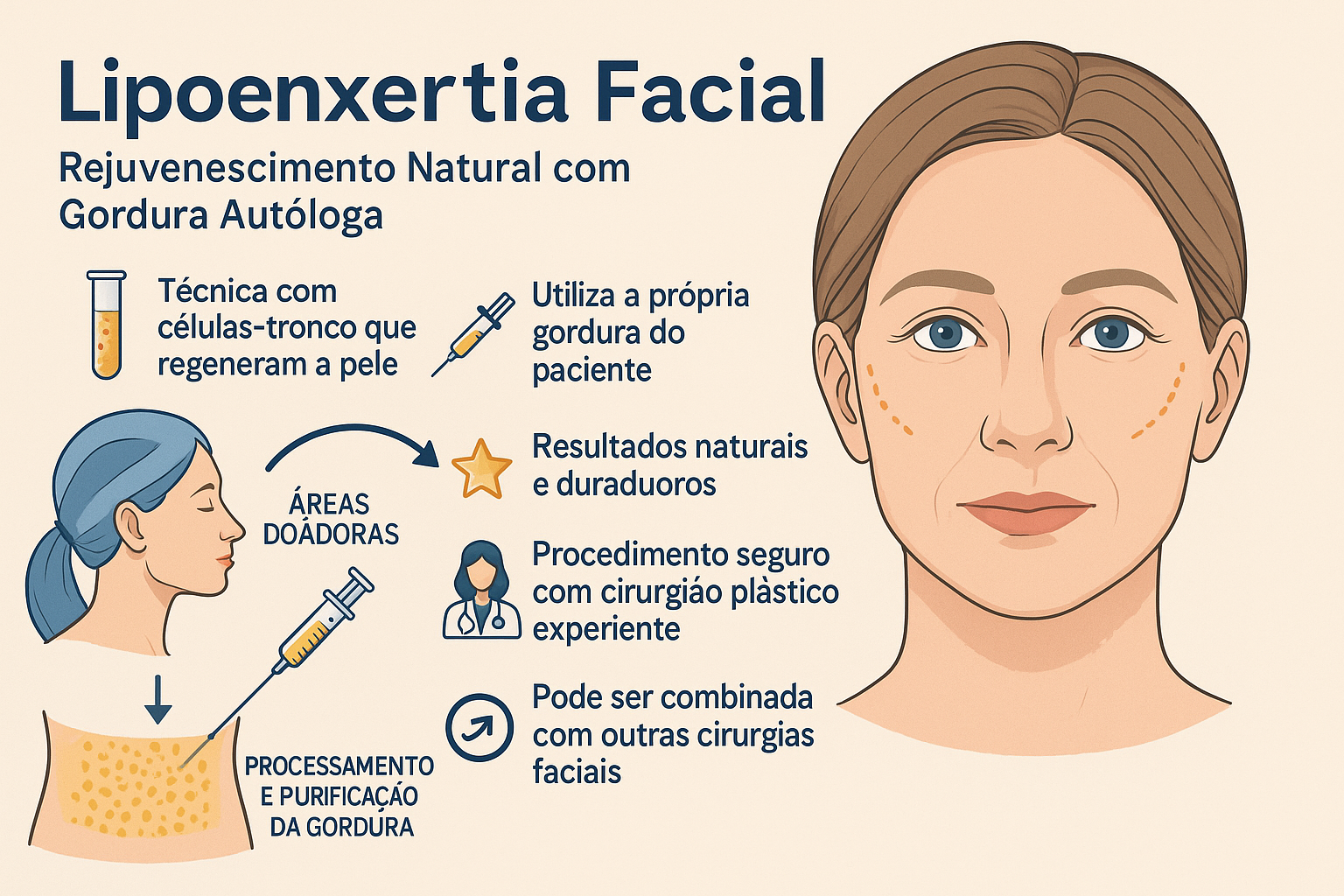
Facial fat grafting. A technique that restores volume, youth, and vitality to the face naturally, using the patient's own fat.
- 🧪 Technique with stem cells that regenerate the skin
- 💉 Uses the patient's own fat
- 🌟 Natural and long-lasting results
- 👩⚕️ Safe procedure with an experienced plastic surgeon
- 🔄 Can be combined with other facial surgeries
🧬 What is Facial Fat Grafting?
Facial fat grafting, also known as autologous fat grafting, is a facial rejuvenation procedure that uses the patient's own fat to restore volume lost due to aging.
Unlike synthetic fillers, the technique is 100% biocompatible, as it does not introduce foreign substances into the body. Thus, the surgeon removes fat by liposuction from donor areas — such as the abdomen, flanks, or thighs — processes it, and reinjects it into facial regions such as folds, under-eye hollows, and cheekbones.
👵 The process of facial aging
- Skin laxity — loss of collagen and elasticity.
- Bone resorption — decrease in supportive bone structure.
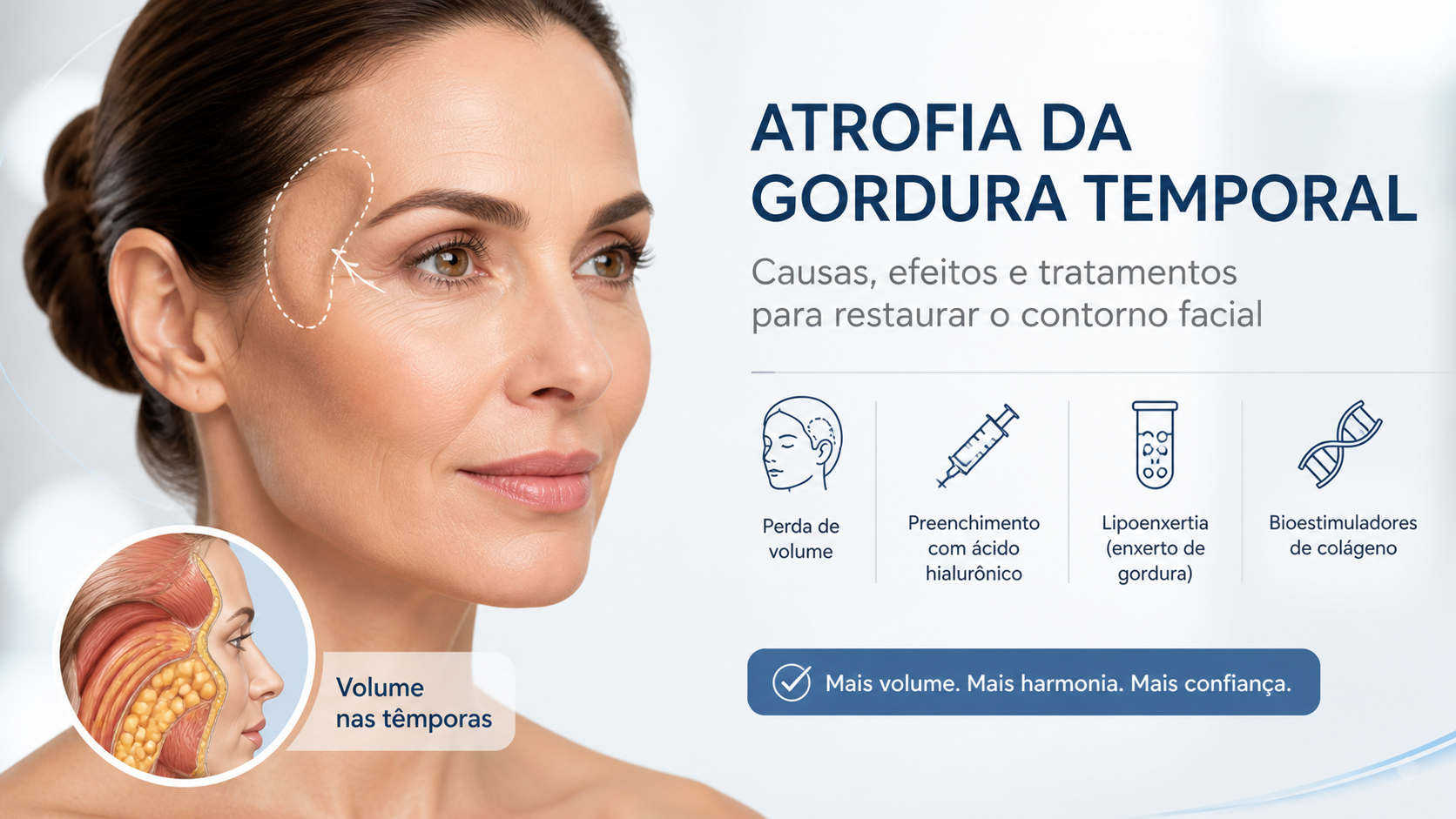
- Loss of facial fat compartments — leading to deep folds and under-eye hollows.
Facial fat grafting therefore restores lost volume and promotes tissue regeneration thanks to the mesenchymal stem cells present in the fat.
🌟 Advantages of Facial Fat Grafting
- Biocompatibility: no risk of rejection or allergy.
- Natural results: accompanies facial expressions.
- Durability: stable effect for years.
- Regenerative effect: improves skin quality.
See also: mammoplasty and mastopexy, surgeries that can also be associated with the use of autologous fat.
🎯 Indications for Facial Fat Grafting
- Nasolabial folds ("marionette lines")
- Deep under-eye hollows
- Malar region (cheekbones)
- Jawline and chin
- Fine wrinkles and global volume loss
Learn more about blepharoplasty, which can be combined with fat grafting.
⚠️ Limitations and Cautions
- Dependence on the surgeon's technique and experience.
- Possible need for a second session.
- Rare but serious complications require safety protocols.
Read about pre-operative exams and post-operative care in plastic surgeries.
🏥 How is the procedure performed?
- Anesthesia — usually local with sedation.
- Fat harvesting by mini-liposuction.
- Fat processing and purification.
- Injection into the face with delicate cannulas.
The surgeon often performs the procedure in a day hospital.
⏳ Recovery and results
- Swelling and bruising for 7–14 days.
- Return to activities in about 1 week.
- Definitive result after 3–6 months.
- Long-lasting effect for years.
🔬 Facial Fat Grafting vs. Synthetic Fillers
| Aspect | Facial Fat Grafting | Synthetic Fillers |
|---|---|---|
| Substance | Autologous fat | Hyaluronic acid and others |
| Duration | Long, stable | 12–18 months |
| Naturalness | High, follows expressions | Good, but limited |
| Regeneration | Yes | No |
📌 Who can undergo this?
Doctors recommend facial fat grafting for healthy patients. Smokers or people with weight fluctuations may have less favorable outcomes.
Read also: risks of smoking in plastic surgeries.
🎥 Recommended video
Would you get Liposuction? Clear your doubts at….
✅ Conclusion
Facial fat grafting is therefore an innovative technique that combines volumization, rejuvenation, and improvement of skin quality. Furthermore, being natural, safe, and long-lasting, it becomes one of the most interesting options for patients seeking discrete and harmonious results.
❓ Frequently Asked Questions about Facial Fat Grafting
What is facial fat grafting?
It is the grafting of the patient's own fat to restore volume and rejuvenate the face. The surgeon collects the fat by liposuction, processes it, and reinjects it into areas that have lost volume.
What are the main indications?
Nasolabial folds, deep under-eye hollows, malar region (cheekbones), jawline and chin contour, as well as global facial volume loss. It can be associated with blepharoplasty and lifting.
How long do the results last?
After 3–6 months, the fat stabilizes. Thus, the fraction that survives tends to be long-lasting for years, accompanying natural aging.
Does it require touch-ups? Is all the fat absorbed?
Part of the graft is reabsorbed in the first few weeks. Thus, in some cases, a second session is recommended to refine the result.
What are the risks and possible complications?
Swelling, bruising, and asymmetries are the most common findings. However, rare complications include infection and accidental intravascular injection. The surgeon's experience, the use of appropriate cannulas, and safety protocols reduce these risks.
What kind of anesthesia is used and where is the procedure performed?
Generally, local anesthesia with sedation is used; the choice depends on the case and associated surgeries. The procedure usually takes place in a day hospital, following the guidelines for anesthesia in plastic surgery.
What is the recovery like?
Swelling and bruises for 7–14 days are expected. Thus, a return to light activities in about 1 week. The final result is usually evaluated after 3–6 months. Follow your surgeon's care tips.
Who should not undergo facial fat grafting?
Patients without medical clearance, with active infection, severe coagulation disorders, or incompatible expectations. Active smoking and significant weight fluctuations can impair graft retention (see risks of smoking).
Does fat grafting replace hyaluronic acid?
In many areas, yes, with the advantage of greater durability and regenerative potential. However, synthetic fillers may be preferred for fine adjustments or when immediate reversibility is desired.
What pre- and post-operative care are important?
Perform pre-operative exams, adjust medications, and maintain a balanced diet. Avoid smoking, alcohol, and sun exposure. Post-operatively, follow guidelines for cold compresses, hygiene, and scheduled follow-up appointments.
Related articles

Diet before and after plastic surgery

Healthy diet in post-operative plastic surgery
Agendar consulta
Precisa de orientação personalizada?
Marque uma avaliação com o Dr. Fernando Amato e tire as suas dúvidas sobre cirurgia plástica.
Falar no WhatsApp