
- Plastic Surgery
Congenital and Acquired Symmastia: What It Is and How to Correct It
- July 23, 2025
- By Fernando Amato
This article addresses the topic of congenital and acquired symmastia, clarifying its characteristics and differences.
Article written with AI assistance and reviewed by Dr. Fernando Amato
🔍 What is Symmastia?
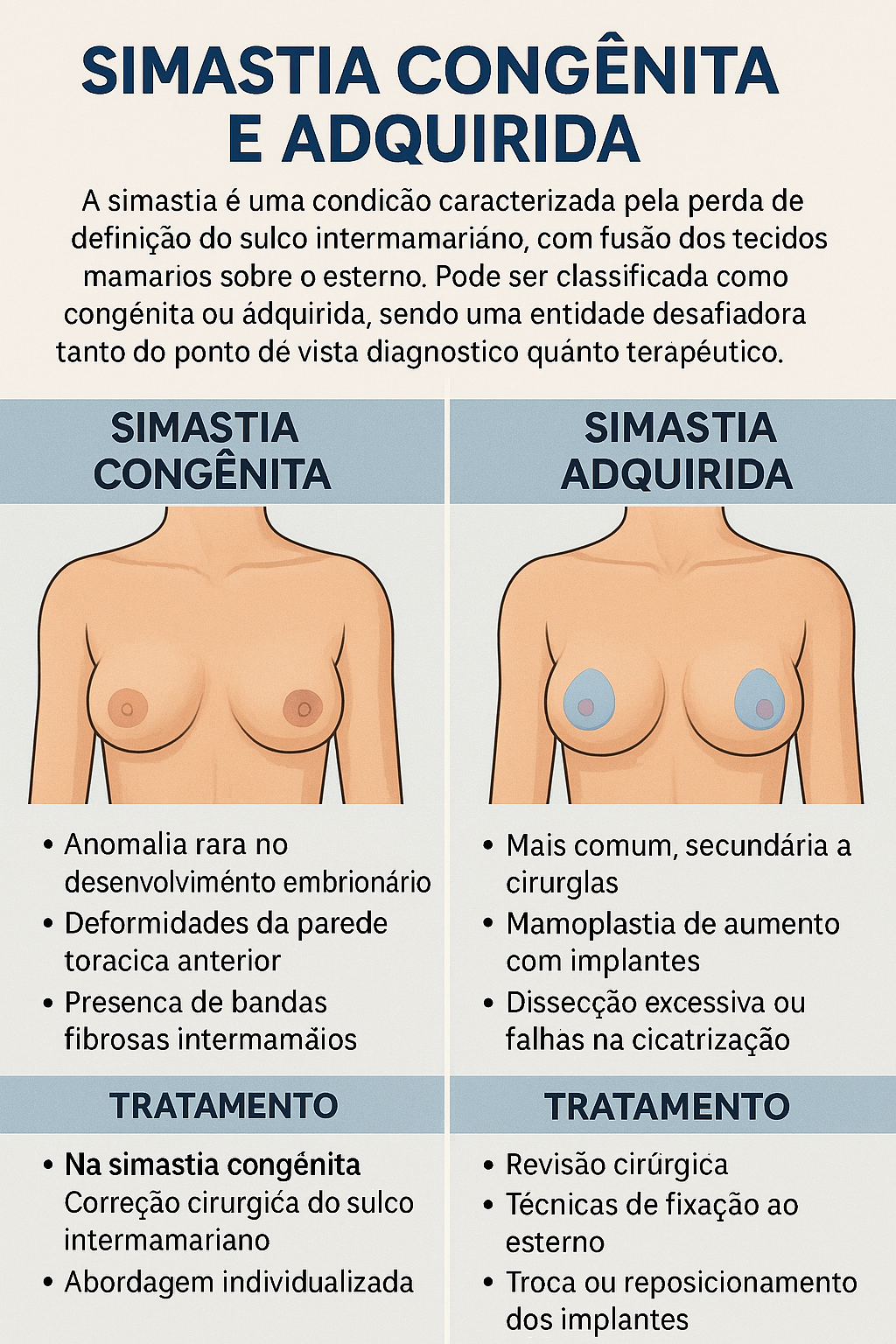
Symmastia is a condition in which the breasts lose their natural separation, joining at the midline over the sternum. Consequently, the normally well-defined inframammary fold becomes absent or imperceptible, creating the appearance of a “uniboob.”
This alteration can be classified as:
- Congenital symmastia: present from birth
- Acquired symmastia: developed throughout life, often after surgeries
Both forms can compromise the patient's aesthetics and self-esteem, and are often corrected by specialized plastic surgery.
🌟 Important Highlights about congenital and acquired symmastia
- 🧬 Can be congenital, due to embryonic development alterations
- 💉 Or acquired, usually after surgery with breast implants
- 🧾 Diagnosis is clinical, based on physical examination
- 🛠️ Treatment almost always requires corrective surgery
- 🧘♀️ Correction must, however, respect breast symmetry and aesthetics
🧬 Congenital Symmastia
Congenital symmastia is a rare anomaly, originating from failures in the embryological development of the thoracic wall. However, it can occur in isolation or associated with genetic syndromes, such as Poland syndrome.
Anatomical characteristics
- Hypertrophy of adipose or fibroglandular tissues over the sternum
- Presence of fibrous bands in the midline
- Thoracic wall deformities
Diagnosis
- Based thus, on physical examination: the breasts are joined at the midline
- However, it can be confused with medial hypertrophy or narrow chest
- In doubtful cases, imaging exams help to delimit structures
🩺 Acquired Symmastia
The acquired form is more common and usually occurs as a complication of breast augmentation, when:
- There is excessive dissection of the medial area when placing implants
- Postoperative hematomas or seromas develop
- There are healing failures, with formation of a medial pseudopocket
Additional causes
- Thoracic trauma
- Radiotherapy or infection
- Extrusion or capsular contracture of implants
Classification of Acquired Symmastia (Zienowicz)
- Mild: breast approximation
- Moderate: partial coalescence
- Severe: complete fusion and absence of inframammary fold
🛠️ Symmastia Treatment
Congenital Symmastia
The treatment is therefore surgical, with aesthetic and functional objectives:
- Removal or repositioning of glandular tissue
- Reconstruction of the inframammary fold with sutures fixed to the sternum
- Careful dissection of presternal fat
Thus, each case requires individual planning, especially when there are associated thoracic alterations.
Acquired Symmastia
Management is surgical and personalized:
- Recreation of the inframammary fold using trans-sternal sutures
- Exchange or repositioning of implants
- Resection of fibrous capsules if contracture is present
- In severe cases, use of biological or synthetic meshes for reinforcement
🎯 Aesthetic Aspects of Correction
Symmastia can, however, deeply affect self-image. Thus, surgical correction aims to restore:
- Natural breast separation
- Breast symmetry
- Thoracic proportion
- Harmony between areolas and the midline
The approach must also consider breast volume, skin elasticity, and history of previous surgeries.
❓ FAQ — Frequently Asked Questions
- What is symmastia?
It is the fusion of breast tissues in the midline, without separation between the breasts. - Is symmastia common?
The congenital form is rare; the acquired form is more common in patients with implants. - What is the main cause of acquired symmastia?
Excessive dissection during breast augmentation. - Can symmastia be prevented?
Yes, with adequate surgical technique and postoperative care. - Does symmastia hurt?
Generally, it does not cause pain, but it can cause aesthetic and emotional discomfort. - How is surgical correction performed?
By fixing the skin to the sternum and possibly exchanging or repositioning the implants. - Does the surgery leave visible scars?
Scars are discreet and strategically positioned. - Can it recur after correction?
Rarely, if the techniques are well executed. - What is the recovery time?
Approximately 2 to 4 weeks, with the use of a thoracic compression garment. - Does symmastia interfere with breastfeeding?
It depends on the previous surgical technique; generally, it does not affect it.
📢 Schedule an Evaluation
In summary, if you notice fusion between your breasts or have had complications after breast surgery, schedule a consultation with a specialized plastic surgeon. Symmastia, therefore, has a solution and can restore self-esteem and harmony to your thoracic contour.
Related articles


Agendar consulta
Precisa de orientação personalizada?
Marque uma avaliação com o Dr. Fernando Amato e tire as suas dúvidas sobre cirurgia plástica.
Falar no WhatsApp