
- Plastic Surgery
Mammoplasty with Mesh: What it is and When it Can be Indicated
- April 28, 2026
- By Fernando Amato
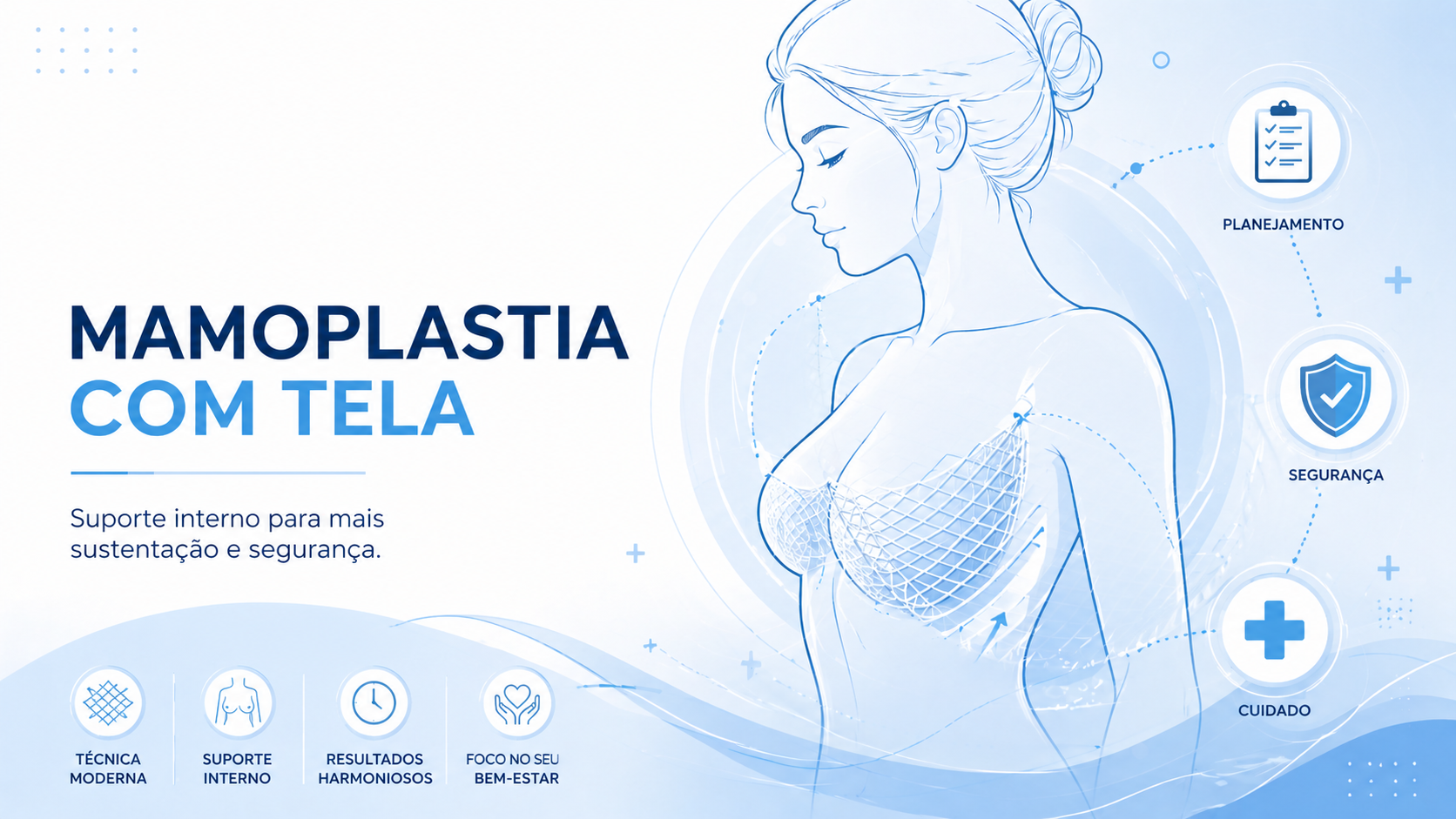
Mammoplasty with mesh is a technique where the surgeon uses a surgical mesh to reinforce breast support. This resource can be used in some mastopexies, reduction mammoplasties, surgeries without implants, breast revisions, or procedures associated with implants.
The mesh acts as an internal support. For this reason, professionals often call it an “internal bra.” This name helps understand the idea, but it must be interpreted with caution: the mesh does not entirely prevent breast sagging, does not stop aging, and does not guarantee a permanent result.
The objective is to offer additional support in selected cases, especially when the patient presents significant laxity, thin skin, loss of tissue firmness, or a higher risk of further breast sagging over time.
What is Mammoplasty with Mesh?
Mammoplasty is a breast reshaping surgery. It can have a reduction, aesthetic, reconstructive, or lifting purpose, depending on the patient's needs.
In mammoplasty with mesh, the surgeon places a surgical mesh inside the breast to reinforce the tissues. It can help support the lower pole, which is the bottom part of the breast and one of the regions most prone to stretching over time.
There are different types of meshes. Some are absorbable, meaning they are gradually reabsorbed by the body. During this process, it is expected that new support tissue will form around the treated area.
Mammoplasty with Mesh and Internal Bra
The term “internal bra” describes a support technique inside the breast. The mesh can function as a kind of net, helping to better distribute the weight of the breast tissue.
This concept is more commonly discussed in patients with mammary ptosis, i.e., breast sagging. Ptosis can occur due to aging, pregnancy, breastfeeding, weight fluctuations, genetics, and loss of skin elasticity.
In Mastopexy, the mesh may be considered when the surgeon identifies a higher risk of loss of support. Still, it is not necessary in all cases.
When Mesh May Be Considered
Mammoplasty with mesh can be evaluated in patients with:
- significant laxity;
- thin skin or skin with many stretch marks;
- breasts prone to sagging;
- significant weight loss;
- previous breast surgeries;
- recurrence of ptosis after mastopexy;
- need for reinforcement in surgeries with or without implants.
In surgeries with implants, the surgeon can use the mesh in specific cases to aid implant stability or correct previous surgical alterations. However, this indication must be made with great discretion.
In mammoplasty without implants, the mesh can help support the patient's own tissue. It does not augment the breast like an implant but can contribute to better internal support when there is enough tissue to reshape.
Does Mesh Replace Implants?
No. Mesh and implants have different functions.
Implants augment or restore volume. Mesh supports tissues. Therefore, a patient who desires a significant increase in breast size may not achieve this goal with mesh alone.
In some cases, the surgeon may discuss alternatives such as mastopexy without implants, implants, fat grafting, or a combination of techniques. The choice depends on the current breast volume, skin quality, degree of sagging, and patient expectations.
What are the Possible Benefits?
The main benefit of mammoplasty with mesh is structural reinforcement. The technique aims to reduce the skin's dependence as the sole responsible for breast support.
This can be useful because the skin, when fragile or very stretched, tends to yield more easily. The mesh can help distribute internal forces and support the repositioned tissue.
In well-selected patients, this reinforcement can contribute to better shape maintenance. However, studies still have limitations, and it is not correct to promise greater durability for all patients.
What are the Limitations?
The mesh does not prevent breast aging. Nor does it completely avoid the effects of gravity, weight fluctuations, future pregnancies, or natural loss of elasticity.
It also does not by itself correct excess skin, asymmetry, overly low areolae, or lack of volume. These points depend on the surgical technique chosen.
Therefore, mesh should be seen as a complementary resource. It can help in some cases but does not replace adequate surgical planning.
Risks and Cautions
Every breast surgery involves risks, such as hematoma, seroma, infection, changes in sensation, wound dehiscence, widened scars, asymmetry, and the need for touch-ups.
When mesh is used, there are also risks related to the biomaterial, such as inflammation, fluid accumulation, infection, local hardening, palpability, or exposure of the mesh. The surgeon does not induce these events but needs to discuss them before surgery.
The pre-operative period is important to reduce risks. Clinical evaluation, exams, control of underlying conditions, smoking cessation when indicated, and medication review are part of safe planning.
Does Mammoplasty with Mesh Last Longer?
This is a frequent question. The most appropriate answer is: it can aid support in selected cases, but it does not guarantee that the result will last longer for all patients.
Durability depends on several factors, such as skin quality, breast weight, surgical technique, scarring, genetics, lifestyle habits, and weight variations.
Therefore, the indication should be individual. The mesh can be useful when there is a clear technical reason to reinforce the tissues.
For Whom it May Not Be Indicated
Mammoplasty with mesh may not be the best option for patients with high surgical risk, active infection, uncontrolled diseases, or expectations incompatible with the procedure.
It also requires caution in smokers, as smoking impairs circulation and healing. In surgeries with greater dissection or the use of biomaterials, this risk can be even more relevant.
The best indication occurs when there is a balance between safety, anatomy, patient desire, and the real benefit of the technique.
Conclusion
Mammoplasty with mesh is a technical option to reinforce internal breast support. It can be useful in cases of significant laxity, fragile tissues, revision surgeries, or a higher risk of recurrent sagging.
Despite this, the mesh does not guarantee a definitive result, does not replace the implant when the goal is volume augmentation, and the surgeon should not use it indiscriminately.
The decision should be made after the plastic surgeon performs an individual assessment, considering skin quality, breast shape, medical history, risks, and realistic expectations.
FAQ
Is mammoplasty with mesh the same as mastopexy?
No. Mastopexy is surgery to lift the breasts. The mesh is just a resource that the surgeon can use in some mastopexies to reinforce support.
Does the mesh replace silicone implants?
No. Implants augment volume. Mesh provides support. They have different functions.
Does the mesh stay in the body permanently?
It depends on the material. Some meshes are absorbable and gradually disappear. Others may be permanent, according to the surgical indication.
Does mammoplasty with mesh prevent the breast from sagging again?
It does not completely prevent it. It can aid support, but the breast remains subject to aging, gravity, weight variations, and skin quality.
Does every patient with laxity need mesh?
No. Many patients achieve good results with conventional techniques. Mesh is usually considered when there is a higher risk of loss of support.
Does the mesh increase the risk of surgery?
It can add specific risks, such as seroma, infection, inflammation, or palpability. Therefore, the benefit must justify its use.
Recommended video: Internal bra: myth or reality in breast surgery?

Related articles


Agendar consulta
Precisa de orientação personalizada?
Marque uma avaliação com o Dr. Fernando Amato e tire as suas dúvidas sobre cirurgia plástica.
Falar no WhatsApp