
- Plastic Surgery
Tuberous Breast: What it is, Causes, and Surgical Correction
- August 9, 2025
- By Fernando Amato
Tuberous Breast. Discover how to identify and treat this rare breast condition that can deeply affect self-esteem.
What it is, causes, and how to correct it surgically
Introduction
The tuberous breast, also called a tubular breast, is a congenital malformation caused by anomalous formation of the mammary gland. Thus, it is characterized by a narrow base, parenchymal hypoplasia, and abnormal elevation of the inframammary fold, often associated with herniation of the breast tissue through the areola. This condition, however, can occur unilaterally or bilaterally, with varying degrees of severity, constituting one of the greatest challenges in aesthetic and reconstructive breast surgery.
💡 Key highlights
- 🧠 Congenital malformation with narrow breast base
- 🩺 Accurate clinical evaluation and grading (I–III)
- 🧩 Specific surgical techniques for each case
- 👩⚕️ Significant psychological impact in adolescence
- 🔄 Lasting results with proper planning
1. Definition and Characteristics
The tuberous breast is described as the result of glandular growth concentrated towards the subareolar pole. This then causes an increase in areolar diameter and accentuated exposure of breast tissue, giving the breast a tubular shape. The malformation is often underdiagnosed in mild stages but becomes evident during puberty or breast development – when the patient seeks treatment before or shortly after 18 years of age.
2. Etiology and Pathogenesis
The exact origin of the tuberous breast, however, is still poorly understood. The most accepted hypothesis points to:
- Anomalous contraction of the mammary tissue fascia, which thus impedes the normal growth of the inferior pole and breast base.
- Formation of “fibrous bands” that restrict lateral and inferior glandular development.
- Surgical observations therefore demonstrate that radial incisions in the fascia release these areas, allowing adequate tissue expansion.
Additional anatomical and molecular studies are therefore needed to clarify possible genetic or environmental causes.
3. Anatomy and Clinical Evaluation
The main clinical manifestations include:
- Narrow breast base
- High and restricted inframammary fold
- Inferior quadrant hypoplasia
- Herniation of breast tissue through the areola
Breast asymmetry is often evident and prompts the search for correction. Clinical examination should evaluate:
- Breast base shape (diameter)
- Fold height and position
- Breast volume and projection
- Areola diameter and projection
- Presence of fibrous bands
Furthermore, three-dimensional evaluation by imaging contributes to precise surgical planning.
4. Classification of Deformity
4.1 von Heimburg Classification
- Grade I: Hypoplasia in the inferomedial quadrant
- Grade II: Both inferior quadrants compromised
- Grade III: Involvement of the entire breast
4.2 Grolleau Classification
- Type I: Moderate hypoplasia in the medial inferior quadrant
- Type II: Hypoplasia in the inferior quadrants
- Type III: Global hypoplasia
4.3 Hammond Algorithm
- Mild constriction
- Constriction with hyperplasia
- Unilateral hypoplasia
- Associated Poland syndrome
- Severe form with herniation
These classifications help technically plan the procedure, but individualized clinical examination makes the difference.
5. Psychosocial Impact
Puberty, however, is a critical phase for body identity. Thus, the tubular shape, dilated areolas, and accentuated asymmetry can generate:
- Body image disorder
- Feelings of inadequacy and social isolation
- Difficulties in sexuality and relationships
Correction, especially in patients ≥14 years old, promotes improved self-esteem, provided that less invasive techniques are prioritized in this public.
6. Pre-operative Evaluation
Before surgery, the following are fundamental:
- Anamnesis: clinical history, expectations, and insurance coverage guarantee
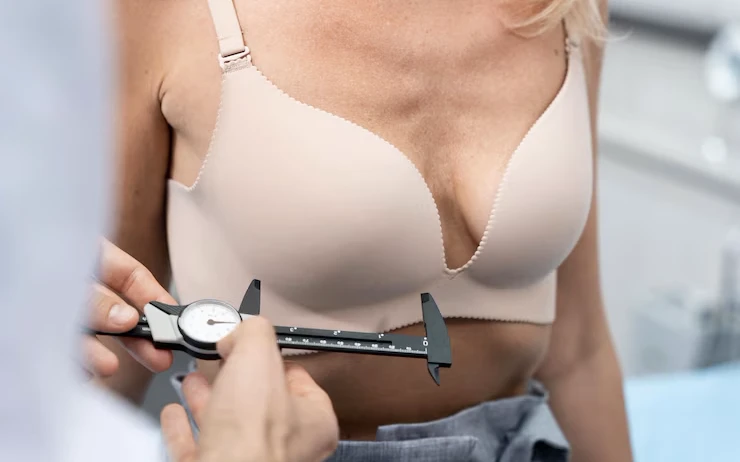
- Physical examination: base measurement, fold, and fibrous tissue evaluation
- Standardized photographs: frontal, profile, and oblique
- 3D imaging: volumetric quantification and simulations
- Surgical plan: choice between direct implant or expander, number of stages, and scars
Thus, clarification about costs, operative stages, and possible limitations ensures confidence.
7. Surgical Planning: Implant vs. Expander
For mild deformities (Grade I), direct implantation, after fascial release, is usually sufficient. However, for moderate to severe deformities (Grade II/III), the use of a tissue expander is recommended to accommodate the implant in the inferior pole and promote adequate symmetry.
8. Surgical Techniques
8.1 Fascia Release (Tethering)
Radial incisions in the inferior pole to thus break fibrous bands and expand breast tissue.
8.2 Periareolar Mastopexy (“round-block”)
This then corrects herniation through the areola, reducing its diameter and repositioning the nipple-areola complex.
8.3 SPAIR Technique
However, in cases of macromastia + constriction, breast reduction with inferior pedicle, internal plication, and areolar reduction are applied.
8.4 Expander in Unilateral Hypoplasia
Subcutaneous expander then used in adolescents to compensate for breast growth and subsequently replaced by a permanent implant.
8.5 Correction in Severe Forms
Two-stage treatment:
- Tissue expansion + radial incisions + mastopexy
- Replacement thus by permanent implant or TRAM flap in complex cases
9. Autologous Techniques
In patients who, however, avoid implants or have thin skin, autologous flaps and grafts are excellent options:
- Pectoral myocutaneous flap or delipo TRAM
- Inferior thoracic flap to support the upper pole and prevent ptosis
- Lipografting (fat grafting)
These techniques then use the patient's own tissue to improve shape and projection.
10. Complications and Risks
The main complications include:
- Persistent asymmetry
- Implant visibility or palpability
- Wide scars (areola/vertical)
- Areolar necrosis (in extensive pedicles)
- Infection or suture dehiscence
Educating the patient about realistic outcomes and risks increases satisfaction.
11. Results and Satisfaction
Studies demonstrate that:
- Well-planned techniques (fascial release + implant/expander) provide stable results
- Long-term satisfaction is high
- Recurrences are rare when complete tissue expansion is used
12. Suggested Reading
- Atiyeh BS et al. Pernipple round-block technique… Aesthet Plast Surg 1998
- Grolleau JL et al. Breast base anomalies… Plast Reconstr Surg 1999
- Rees TD, Aston SJ. The tuberous breast. Clin Plast Surg 1976
- Hoffmann S. Two-stage correction… Plast Reconstr Surg 1982
- von Heimburg D et al. The tuberous breast deformity… Br J Plast Surg 1996
13. Conclusion
In summary, tuberous breast requires early diagnosis, proper classification, and personalized technique selection. The use of fascial release, mastopexy, expanders, or flaps offers effective solutions for correcting shape and volume, with results that bring physical and emotional well-being. Therefore, multidisciplinary follow-up and pre-operative clarification are essential for success.
FAQ
Question 1: What causes tuberous breast?
Answer: It is believed to be due to anomalous contraction of the mammary fascia, which prevents normal growth of the inferior pole.
Question 2: How do I know if my breast is tuberous?
Answer: Evaluate for a narrow base, high fold, dilated areola, and tissue herniation through imaging and clinical examination.
Question 3: When to operate for tuberous breast correction?
Answer: Adolescents from 14 years of age can undergo surgery, especially in psychosocial cases.
Question 4: Is the surgery done in one or two stages?
Answer: It depends on the severity; mild cases are usually a single stage, severe cases in two stages with an expander.
Question 5: Can it be corrected without an implant?
Answer: Yes, with autologous techniques such as TRAM or local flaps in suitable patients.
Question 6: What are the risks of surgery?
Answer: Asymmetry, scars, necrosis, infection, and implant palpability are the main ones.
Question 7: Do the results last a lifetime?
Answer: Yes, with a well-performed technique; fluctuations can occur with aging or pregnancy.
Question 8: Can tuberous breast affect breastfeeding?
Answer: It may have a mild impact, but many women breastfeed normally after correction.
Question 9: Does insurance cover this surgery?
Answer: It depends on the plan and justification. Aesthetic surgeries are often not covered.
Question 10: How long does recovery take?
Answer: Return to daily activities is possible in 1–2 weeks; intense activities in 4–6 weeks.
Related articles


Agendar consulta
Precisa de orientação personalizada?
Marque uma avaliação com o Dr. Fernando Amato e tire as suas dúvidas sobre cirurgia plástica.
Falar no WhatsApp