
- Plastic Surgery
Facial fat grafting combined with facelift: why the combined approach is essential
- April 16, 2026
- By Fernando Amato
Facial fat grafting associated with facelift signifies a major evolution in facial plastic surgery. Instead of only treating sagging by tissue traction, this approach restores lost volume and improves skin quality in an integrated and harmonious way.
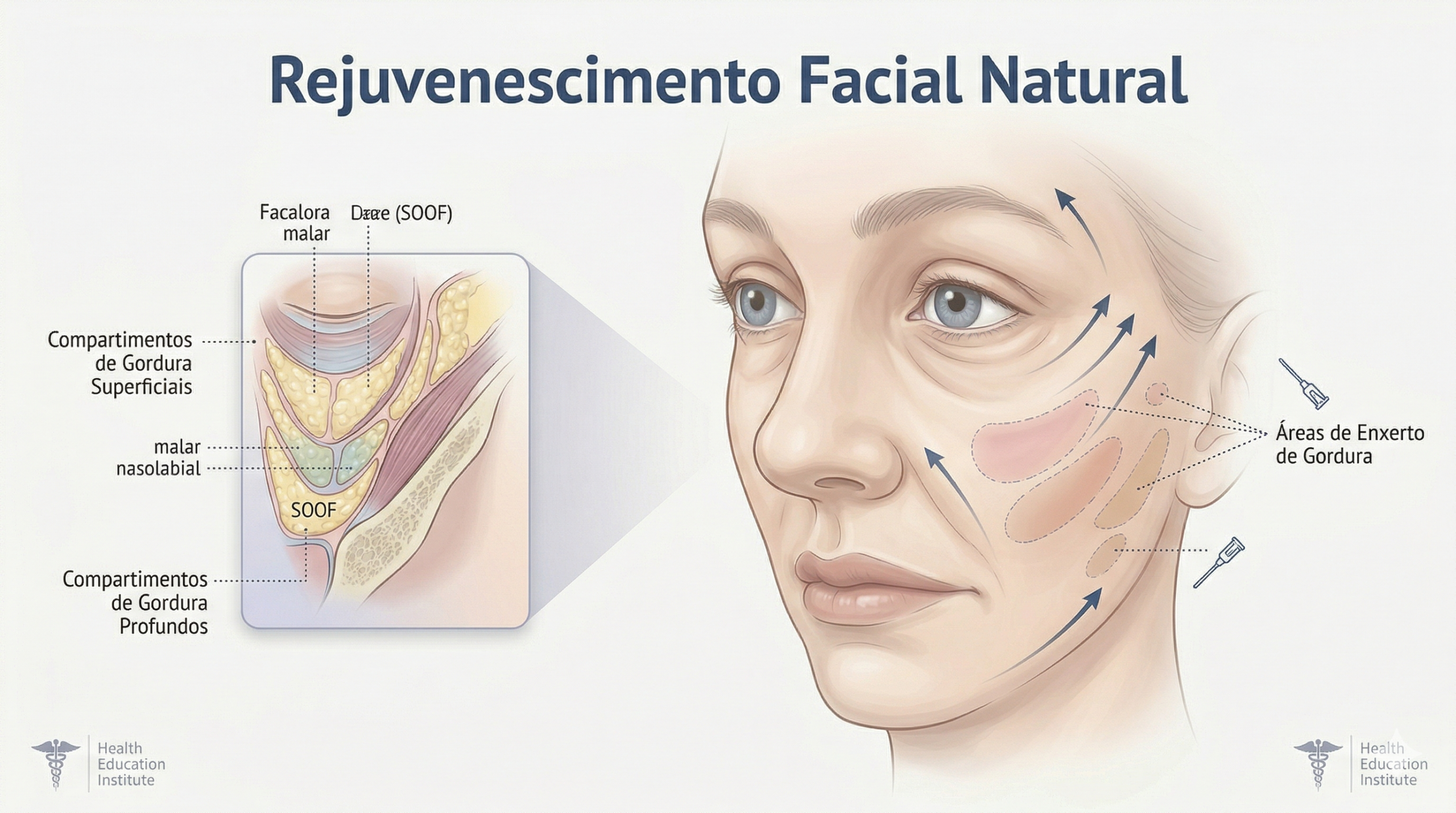
Facial aging is multifactorial. It involves bone loss—especially of the maxilla—reduction and displacement of fat pads (natural structures that support the face), and skin changes, such as loss of elasticity and the appearance of blemishes. Given this, modern rejuvenation is not limited to lifting: it combines tissue repositioning, volumetric replacement with fat, and technologies that effectively improve the skin.
Facial fat grafting and the role of bone loss and fat pads
Over the years, the bony projection of the face undergoes progressive reduction, especially in the midface. The maxilla loses height and support, which directly compromises the upper lip and the malar (cheekbone) region.
Similarly, fat pads undergo distinct changes over time:
- Deep fat pads: lose volume and descend, compromising facial structure.
- Superficial fat pads: contribute to sagging and skin “detachment.”
This combination generates furrows, dark circles, loss of contour, and an aged appearance. Therefore, the ideal treatment involves three simultaneous fronts:
- Repositioning with lifting
- Volume replacement with fat grafting
- Skin improvement with specific technologies
It's worth noting that this reasoning also applies to other surgeries, such as mammoplasty and mastopexy, where repositioning and volume go hand in hand.
Fat grafting planning by anatomical compartments
One of the main technical advances in the field is planning by anatomical compartments, which involves treating each facial region individually, with specific and well-defined volumes.
Fat grafting cannot be performed empirically. In practice, it requires:
- Detailed prior planning
- Volume estimation in millimeters
- Checklist of areas to be treated
This precision is comparable to facelift planning and surgical anesthesia, as discussed in anesthesia in plastic surgery. Furthermore, each patient has their own characteristics; therefore, there are no universal measures applicable to all cases.
Micrografting technique: how to avoid irregularities
The most commonly used technique today is micrografting—also called microfat—which consists of applying small amounts of fat in a distributed and controlled manner.
The fundamental principles of this approach include:
- Fractionated deposition, in small quantities per pass
- Continuous cannula movement during application
- Avoid the formation of “boluses” (concentrated fat accumulations)
As a result, this methodology significantly reduces the risk of nodules, asymmetries, and visible irregularities. The fat is applied in different anatomical planes:
- Supraperiosteal: close to the bone, for structural support
- Subdermal: more superficial, for contour refinement
Together, these technical precautions increase the predictability of results and contribute to a more natural appearance in the postoperative period.
Infraorbital region and midface
The area between the lower eyelid and the cheekbone—known as the “tear trough”—is one of the most challenging in facial rejuvenation. To treat it properly, the surgeon performs deep filling for structural support and then applies a superficial complement for softening the transition.
The deep malar fat pad, in turn, is considered an almost universal target in these procedures. Its replacement helps restore:
- The natural projection of the face
- Midface support
- Smooth transition between eyelid and cheek
Regardless of the technique chosen, it is essential to respect important vascular structures—such as the facial artery—to ensure patient safety throughout the entire procedure.
Fat grafting in the lips: naturalness above all
Lip treatment with fat grafting requires extra attention. The most common mistake is creating a uniform and artificial volume, popularly known as the “sausage” effect, which compromises both aesthetics and the naturalness of the result.
In contrast, the modern approach prioritizes:
- Respect for the labial tubercles, which are natural lip structures
- Construction of the central tubercle with adequate definition
- Definition of the lateral tubercles for overall harmony
To achieve this goal, the technique includes retroinjection with precise microdeposits, short and controlled movements, and light massage for homogeneous fat distribution. In short, the goal is to preserve proportion, contour, and naturalness at all stages of the procedure.
Skin technologies in facelift: fractional CO2 and microneedling
In addition to volume and structure, skin quality is an essential pillar of modern rejuvenation. In this context, fractional CO2 laser is one of the main technologies used in combination with facelift. It promotes skin renewal, texture improvement, and blemish lightening.
However, its use requires caution, especially in patients with a tendency to hyperpigmentation. According to the American Society for Dermatologic Surgery, ablative lasers should be carefully indicated in higher Fitzpatrick skin types.
Complementarily, microneedling is another important resource in this scenario. It thus stimulates collagen production, improves acne scars, and facilitates the penetration of topical agents—a technique known as “drug delivery.” The choice among available technologies depends on the clinical objective:
- Skin retraction: radiofrequency or fractional CO2
- Delivery of active ingredients: microneedling with specific protocols
In both cases, these treatments can be performed in an appropriate setting, such as an outpatient surgery center, ensuring safety and efficient recovery for the patient.
Postoperative care and prolonged care
Care after the procedure is crucial for the quality of the final result. In general, protocols usually include the use of creams for about 15 days, strict photoprotection, and maintaining care for a period of 3 to 6 months.
Among the most used active ingredients in this phase are:
- Retinoids: vitamin A derivatives that stimulate cell renewal
- Hydroxy acids: chemical exfoliants that improve skin texture
- Antioxidants: which protect and stabilize the obtained result
In addition, habits such as a balanced diet and cessation of smoking directly impact healing and the quality of results. Before surgery, the patient must also strictly follow instructions on preoperative exams and proper preparation.
Lip lift and suture selection
In procedures such as a lip lift—surgical elevation of the upper lip—technical details make a significant difference to the final result. Clinical observations suggest that absorbable sutures may increase the risk of dehiscence (suture opening). In contrast, fine non-absorbable sutures tend to offer greater safety and stability. This decision should always be individualized, taking into account the patient's clinical history and anatomical characteristics.
Natural results: the primary goal of facial surgery
Modern facial plastic surgery aims for a discreet and harmonious result. The patient should thus look rested and rejuvenated—not “operated.” Therefore, it is fundamental to combine individualized planning, refined technique, and integration between structure, volume, and skin quality.
In the same way, the principles of facial fat grafting can be applied to other areas of the body, always focusing on naturalness and respect for the individual proportions of each patient.
Conclusion
In summary, facial fat grafting combined with facelift represents a complete and contemporary approach to aging. By simultaneously treating volume, position, and skin quality, it becomes possible to achieve more harmonious and lasting results. Still, each case must be evaluated individually, and the decision about techniques, volumes, and technologies should always be made in conjunction with a qualified and trusted plastic surgeon.
FAQ
What is facial fat grafting? It is the transfer of fat from one's own body to the face, with the aim of restoring volume and improving contours naturally.
Does fat grafting replace a facelift? No. It complements the facelift, which repositions tissues. The graft, in turn, replaces the volume lost during aging.
Is grafted fat permanent? Part of the fat is reabsorbed by the body. The fraction that integrates into the tissues, however, can have a lasting effect.
Is the procedure safe? Yes. When performed by a qualified professional in an appropriate environment, the procedure is considered safe.
What is the difference between microfat and traditional grafting? Microfat uses smaller particles and more precise application, which reduces the risk of irregularities and improves the aesthetic result.
Is CO2 laser mandatory in facelift? No. It is a complement indicated according to the skin needs of each patient.
Can microneedling be done along with surgery? Yes, in selected cases, as part of a combined treatment plan.
Can the lip look artificial after the procedure? It can, if the technique is poorly executed. The correct approach, however, avoids this undesirable aspect.
How long does recovery take? It varies from patient to patient, but generally a few weeks are needed for social return and a few months for the final result to stabilize.
Who cannot undergo the procedure? Patients with uncontrolled diseases or unrealistic expectations should be evaluated carefully before any surgical decision.
Related articles


Agendar consulta
Precisa de orientação personalizada?
Marque uma avaliação com o Dr. Fernando Amato e tire as suas dúvidas sobre cirurgia plástica.
Falar no WhatsApp