
- Plastic Surgery
Temporal Fat Atrophy: causes, consequences, and treatments
- May 4, 2026
- By Fernando Amato
Temporal fat atrophy is the loss of volume in the temples, creating a sunken appearance on the sides of the face. This is a common sign of facial aging, but it can also appear after significant weight loss, chronic illnesses, use of certain medications, or local muscle atrophy.
Even though it is a small area, the temple greatly influences facial harmony. When it loses volume, the transition between the forehead, eyes, and cheekbones becomes more pronounced. The result can be a more tired, aged, and, in some cases, more skeletal appearance.
What causes temporal fat atrophy?
The most frequent cause is natural aging. Over time, there is a reduction in fat compartments, skin changes, and bone remodeling, which alters the facial contour.
Significant weight loss can also make the temples appear more sunken, especially in people with thinner faces. Additionally, some diseases and treatments can cause facial lipoatrophy, which is the abnormal loss of fat in certain regions of the face.
In some patients, atrophy of the temporal muscle also contributes to local hollowing. Therefore, not all sunken temples have the same cause, and individual assessment is essential.
How the loss of volume in the temples affects facial aesthetics
The main consequence is an aged appearance. The face loses continuity between the forehead and the midface, making the contour less smooth. This can highlight the zygomatic arch more and give a tired or emaciated facial appearance.
Temporal atrophy can also accentuate asymmetries and contribute to a subtle drooping of the eyebrow tail. In some cases, the complaint is associated with other changes in the eye region, which may require an integrated evaluation with treatments such as blepharoplasty or broader strategies for advanced facial rejuvenation.
Treatments for temporal fat atrophy
Treatment depends on the cause, the intensity of volume loss, and the patient's anatomy.
Hyaluronic acid fillers are the most commonly used non-surgical option. They allow for immediate volume restoration, precise adjustment, and the possibility of reversal with hyaluronidase when necessary. It is a common alternative in mild to moderate cases.
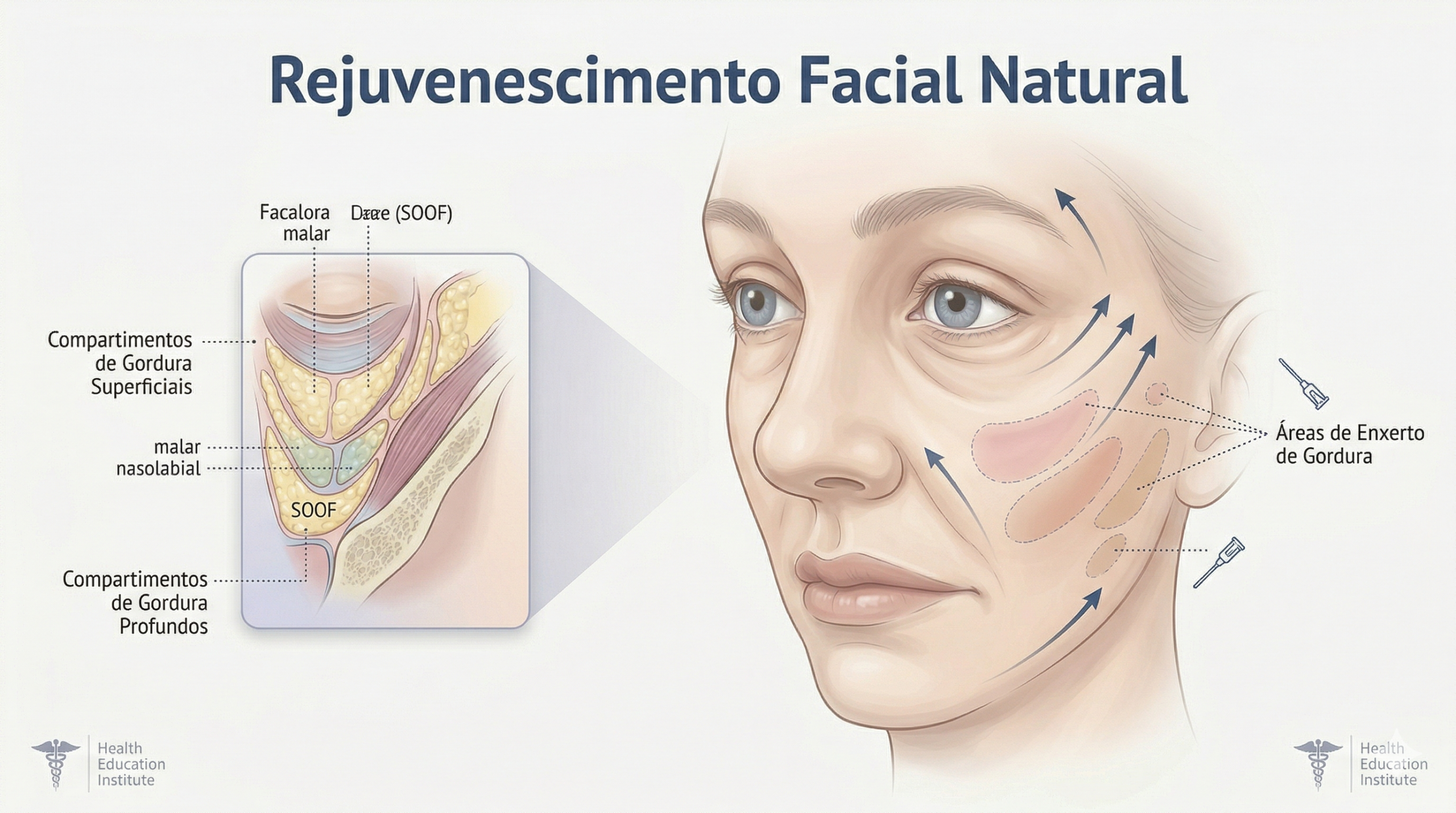
Lipoenxertia, or fat grafting, uses the patient's own fat to fill the temporal region. It may be interesting for those who need greater volume replacement or seek a potentially more lasting solution. When well-indicated, it can also be combined with other facial rejuvenation approaches. To learn more, check out the content on facial fat grafting.
Collagen biostimulators, microneedling radiofrequency, lasers, and microfocused ultrasound can complement the treatment, especially when there is skin laxity and worsening skin quality. These methods do not replace volumization when the main complaint is hollowing of the temples, but they can improve the overall result.
Why medical evaluation is indispensable
The temporal region has complex anatomy, with important vessels, nerves, and deep planes. Therefore, treatment should only be performed after careful medical evaluation.
More than just filling a sunken area, the goal is to restore natural proportions and maintain the safety of the procedure. Not all sunken temples require the same treatment, and not every case is just aging. In some situations, significant weight loss, diseases, or recent asymmetries need to be investigated before any procedure.
FAQ
Is temporal fat atrophy normal with age?
Yes, it is a common change with facial aging. However, the intensity varies greatly among people and can be aggravated by weight loss, diseases, and individual factors.
Is temporal filling always the best option?
No. Hyaluronic acid fillers are widely used, but the choice depends on the degree of atrophy, anatomy, and the overall facial treatment plan.
Does fat grafting last longer than hyaluronic acid?
Generally, grafted fat can offer more lasting results. However, graft integration varies among patients, and the indication must be individualized.
Can biostimulators resolve sunken temples?
They can help with skin firmness and quality, but they do not always sufficiently replenish lost volume. Often, they work best as a complement.
Are there risks in this type of treatment?
Yes. The temporal region is anatomically delicate. Therefore, safety depends on adequate evaluation, correct technique, and profound knowledge of the treated area.
Recommended video: Facial lift – The surgery that makes the FACE younger — https://www.youtube.com/watch?v=BLOvXmxd-TE

Related articles



Agendar consulta
Precisa de orientação personalizada?
Marque uma avaliação com o Dr. Fernando Amato e tire as suas dúvidas sobre cirurgia plástica.
Falar no WhatsApp