
- Plastic Surgery
7 signs your silicone implant has ruptured
- February 11, 2026
- By Fernando Amato
Signs of silicone implant rupture are not always visible, but the body usually sends clear signals — recognizing these signs prevents complications and treatment delays
Silicone implants are widely used in aesthetic and reconstructive breast surgeries, with a high level of safety. Still, no implant is permanent. Over time, mechanical factors, material aging, or trauma can lead to rupture. Therefore, early recognition of silicone implant rupture signs is crucial to prevent chronic inflammation, capsular contracture, and silicone migration.
However, unlike saline implants, whose rupture is quickly noticeable by a loss of volume, silicone implants can rupture silently. This happens especially when the extravasation remains contained by the fibrous capsule (intracapsular rupture).
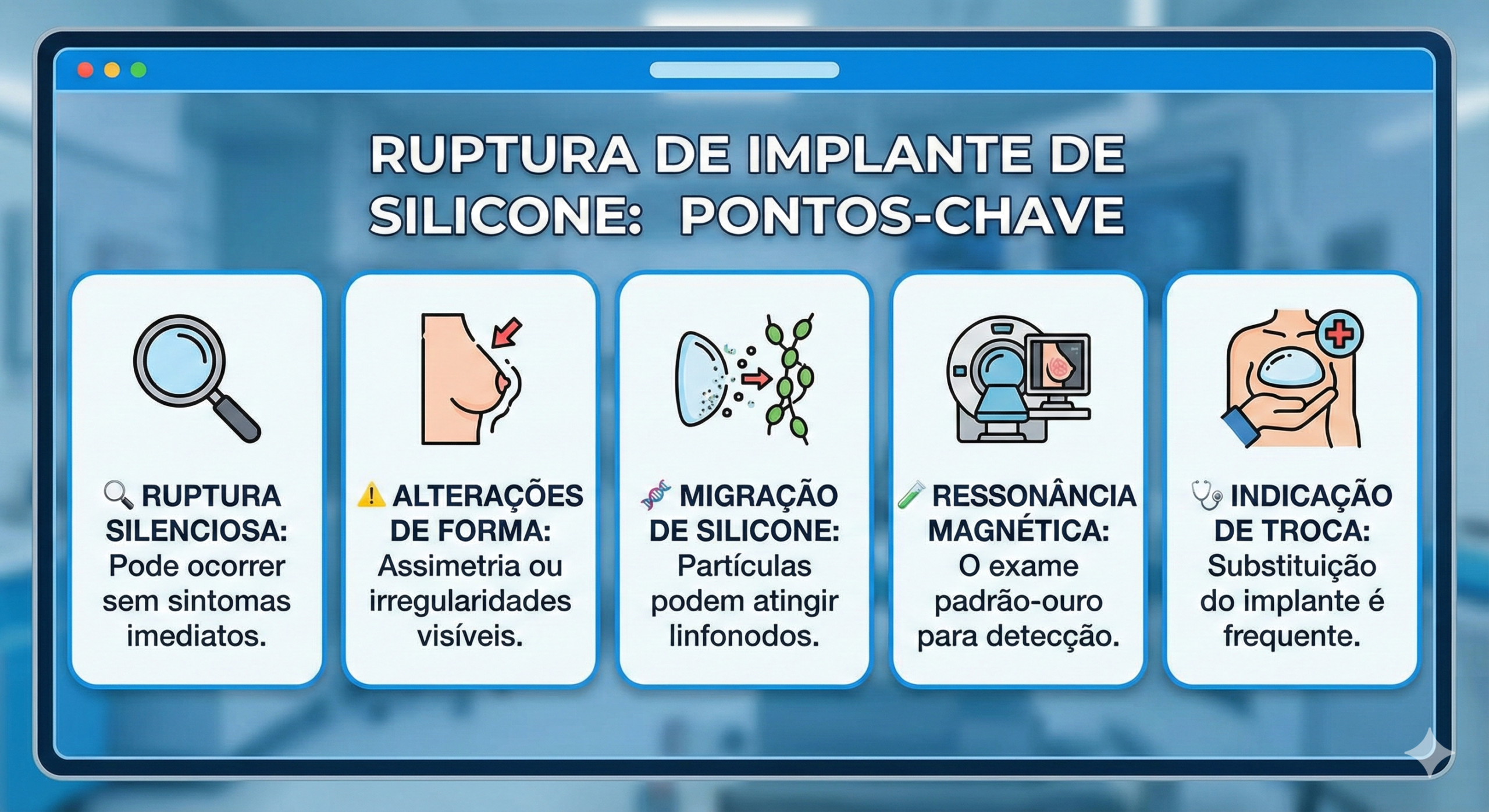
🔍 Rupture can be silent
⚠️ Shape changes are frequent signs
🧬 Silicone can migrate to lymph nodes
🧪 MRI is the gold standard exam
🩺 Doctors usually recommend implant replacement
1. Change in breast shape
Firstly, among the main signs of silicone implant rupture, a change in breast shape is one of the most observed. In this case, the breast may present:
- Partial flattening
- Loss of projection
- Contour irregularities
- Asymmetry compared to the contralateral breast
These changes, therefore, result from the loss of the implant's structural integrity and the redistribution of the silicone gel.
Reference: Nahabedian MY. Clin Plast Surg. 2015.
Useful links:
2. Change in breast size
Secondly, volume variation can occur both for more and for less.
For example, in saline implants, reduction is rapid. In silicone implants, volume may decrease slowly or even appear increased due to local inflammation.
Therefore, this sign should always be investigated.
Reference: FDA. Breast Implant Rupture. 2020.
Useful links:
3. Local pain or tenderness
Although many ruptures are asymptomatic, pain can indicate extracapsular extravasation. In this context, silicone outside the implant can cause an inflammatory reaction, thus leading to:
- Spontaneous pain
- Tenderness to touch
- Sensation of breast heaviness
Reference: Hölmich LR et al. Plast Reconstr Surg. 2004.
4. Breast hardening (capsular contracture)
Furthermore, the presence of free silicone can stimulate exaggerated fibrosis of the capsule around the implant. Consequently, this leads to capsular contracture, characterized by:
- Rigid breast
- Artificial rounded shape
- Progressive pain
- Breast elevation
Reference: Deva AK et al. Aesthetic Surg J. 2019.
Useful links:
Smoking risks | Pre-operative exams
5. Swelling or unilateral enlargement
Similarly, the appearance of edema or late seroma can be one of the signs of silicone implant rupture. For this reason, this finding requires careful investigation to rule out other conditions, such as infection or implant-associated lymphoma (BIA-ALCL).
Reference: Handel N. Plast Reconstr Surg. 2006.
6. Palpable ripples and irregularities
Additionally, visible or palpable ripples may appear when the implant loses its internal structure. It is worth noting that this finding is more common in thin patients or when the implant is in a subglandular plane.
Reference: Spear SL. Aesthetic Surg J. 2007.
Useful links:
7. Breast lumps or enlarged lymph nodes
Finally, silicone can migrate to adjacent tissues, forming granulomas or enlarging axillary lymph nodes. Although these findings often cause oncological concern, they generally represent an inflammatory reaction to silicone.
Reference: Brown SL. Radiographics. 2004.
Useful links:
How to confirm implant rupture
To confirm the diagnosis, doctors require imaging tests.
Magnetic Resonance Imaging (MRI)
Considered the gold standard, with sensitivity greater than 90%. Furthermore, it identifies classic signs such as the linguine sign.
Ultrasound
Serves as a good initial tool. Thus, it assesses implant integrity and the presence of fluid.
Mammography
Despite being less sensitive for silicone, it is still important for oncological screening.
References:
- Cher DJ. JAMA. 2001.
- Hölmich LR. Plast Reconstr Surg. 2005.
Treatment
Although implant rupture is not an emergency, implant replacement or removal is generally recommended. In this regard, the surgical plan may include:
- Removal of the ruptured implant
- Partial or total capsulectomy
- Replacement with a modern implant
- Eventually, association with mastopexy
Additional links:
Conclusion
In summary, signs of silicone implant rupture are not always evident. Therefore, regular follow-up and attention to bodily changes are essential. At the slightest sign of alteration, evaluation by a plastic surgeon is indispensable.
Schedule a specialized consultation for a safe and individualized diagnosis.
Would you undergo Liposuction? Clear your doubts
Related articles


Agendar consulta
Precisa de orientação personalizada?
Marque uma avaliação com o Dr. Fernando Amato e tire as suas dúvidas sobre cirurgia plástica.
Falar no WhatsApp