
- Plastic Surgery
Ultrasound Signs Indicating Complications with Breast Implants
- October 30, 2025
- By Fernando Amato
Discover how breast implant complication ultrasonography can identify problems early after breast surgery — including the famous “snowstorm sign.”
Ultrasound and Breast Implants: an essential tool
Breast implant complication ultrasonography is a first-line imaging exam for evaluating silicone implants.
It allows for the identification of everything from ruptures to seromas and capsular contractures, without radiation exposure and with excellent cost-benefit.
However, with the increasing number of breast augmentation surgeries (learn more here), the importance of imaging follow-up has also grown — especially several years after implantation.
- Evaluates implant integrity without the need for contrast
- Detects intracapsular and extracapsular ruptures
- Identifies complications such as seromas and contractures
- It is safe, painless, and widely available
- Complements mammography and magnetic resonance imaging
Main Complications Detectable by Ultrasound
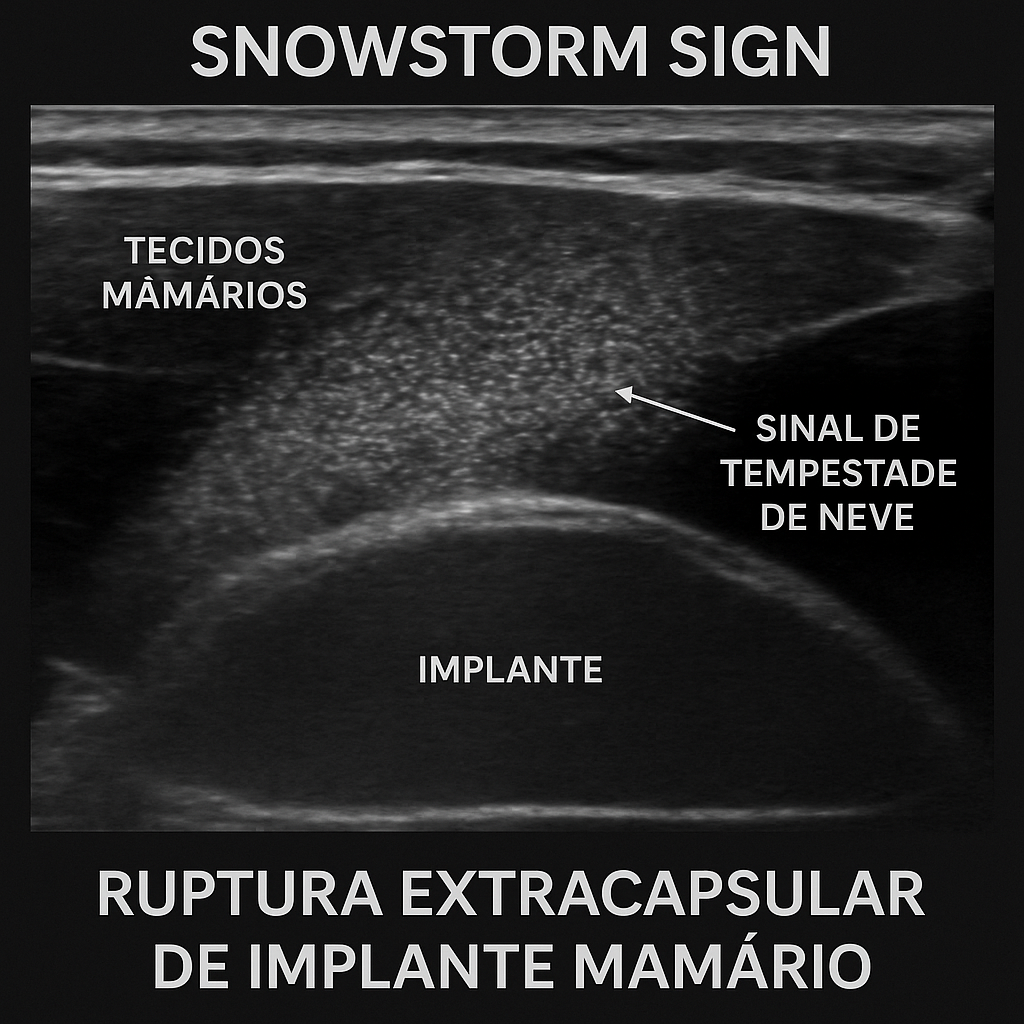
1. Extracapsular Rupture — the “Snowstorm Sign”
Extracapsular rupture occurs when the silicone passes beyond both the implant shell and the fibrous capsule the body forms around it.
The ultrasound then shows a diffuse echogenic appearance, with bright and blurred echoes — the famous “snowstorm sign”.
- What it means: free silicone infiltrating breast tissue.
- Why it matters: indicates complete implant rupture and requires surgical evaluation.
- Where it appears: adjacent breast tissue and axillary lymph nodes (siliconomas).
💡 The “snowstorm sign” is considered pathognomonic for extracapsular rupture.
2. Intracapsular Rupture — “Step-ladder” and “Linguine”
In intracapsular rupture, the silicone is still contained by the fibrous capsule.
The most common signs are:
- Step-ladder sign: multiple parallel echogenic lines within the implant.
- Linguine sign: thin folds of the shell floating in the silicone.
🔹 Interpretation: internal implant failure, without extravasation into the breast tissue.
🔹 Management: clinical follow-up or implant replacement, depending on symptoms.
3. Periprosthetic Seroma
A seroma is a collection of fluid around the implant. It can occur soon after surgery or years later.
On ultrasound, it appears as an anechoic collection (clear fluid) or heterogeneous (with debris).
🔹 Attention: late seromas should be investigated to rule out breast implant-associated anaplastic large cell lymphoma (BIA-ALCL).
🔹 Read more: pre-operative exams and surgical safety.
4. Capsular Contracture
Capsular contracture is a body reaction to the presence of the implant, leading to fibrosis and hardening of the breast.
Ultrasound shows capsule thickening, contour deformation, and increased periprosthetic echogenicity.
🔹 Clinical symptoms: pain, stiffness, and alteration of breast shape.
🔹 Treatment: may require revision surgery.
5. Silicone Migration — Siliconoma
After extracapsular rupture, silicone can migrate to the axillary lymph nodes.
These lymph nodes present a diffuse echogenic pattern, similar to the snowstorm sign, and may be palpable.
🔹 Importance: although benign, siliconoma must be differentiated from metastasis in patients with a history of breast cancer.
6. Infection and Inflammation
Ultrasound is useful for identifying collections, increased vascularization, and skin thickening.
These signs suggest infection, which requires rapid treatment.
🔹 Pre- and post-operative care: check essential medical tips here.
Comparison of Imaging Methods
| Method | Advantages | Limitations | Ideal for |
|---|---|---|---|
| Ultrasound | Accessible, no radiation | Limited evaluation in very dense implants | Initial detection and follow-up |
| Magnetic Resonance Imaging (MRI) | High sensitivity | High cost | Confirmation of intracapsular rupture |
| Mammography | Evaluates adjacent breast tissue | Difficulty visualizing the implant | Oncological screening |
🔗 Learn more about anesthesia in plastic surgery and specialized day hospitals.
When to perform control ultrasound
- Every 2 to 3 years after surgery.
- Whenever there is pain, hardening, or change in shape.
- After trauma or suspected rupture.
- In the follow-up of surgeries like mastopexy with prosthesis or cruroplasty.
Conclusion
In summary, breast implant complication ultrasonography is an essential exam for the safety and longevity of aesthetic results.
The snowstorm sign is a classic finding that reveals extracapsular rupture, requiring specialized medical evaluation.
However, if you have implants and have noticed changes in your breast, consult a plastic surgeon or mastologist. Early diagnosis is key to maintaining your health and surgical outcome.
Schedule your consultation with a specialist for personalized evaluation and guidance.
8. FAQ
1. What is the “snowstorm sign”?
It is an ultrasonographic finding that indicates free silicone in breast tissue, typical of extracapsular rupture.
2. Does ultrasound detect all ruptures?
Not always — magnetic resonance imaging may be necessary to confirm small intracapsular ruptures.
3. Can I have an ultrasound even with an old implant?
Yes. It is safe and recommended periodically.
4. Can silicone leak into lymph nodes?
Yes. This forms what are called siliconomas, visible on ultrasound.
5. How do I know if I need to replace the implant?
Replacement is indicated in case of rupture, severe contracture, or clinical complications.
6. Is seroma around the implant dangerous?
It depends. Late seromas need to be investigated to rule out lymphoma.
7. Does the exam hurt?
No. It is painless and quick.
8. Can I have an ultrasound while breastfeeding?
Yes, as long as indicated and with medical guidance.
9. Does capsular contracture appear on ultrasound?
Yes. The exam shows thickening and deformation of the fibrous capsule.
10. Who should interpret the exam?
Radiologists and mastologists trained in breast imaging with implants.
9. Recommended Video
🎬 Dr. Fernando Amato explains: Breast Reconstruction — Plastic Surgery
Related articles


Agendar consulta
Precisa de orientação personalizada?
Marque uma avaliação com o Dr. Fernando Amato e tire as suas dúvidas sobre cirurgia plástica.
Falar no WhatsApp