
- Plastic Surgery
Mammogram acronyms in the report: how to interpret RRA, QSL, JQM and other acronyms
- October 9, 2025
- By Fernando Amato
Discover what the anatomical acronyms in mammogram reports mean — and how this helps in understanding and treatment.
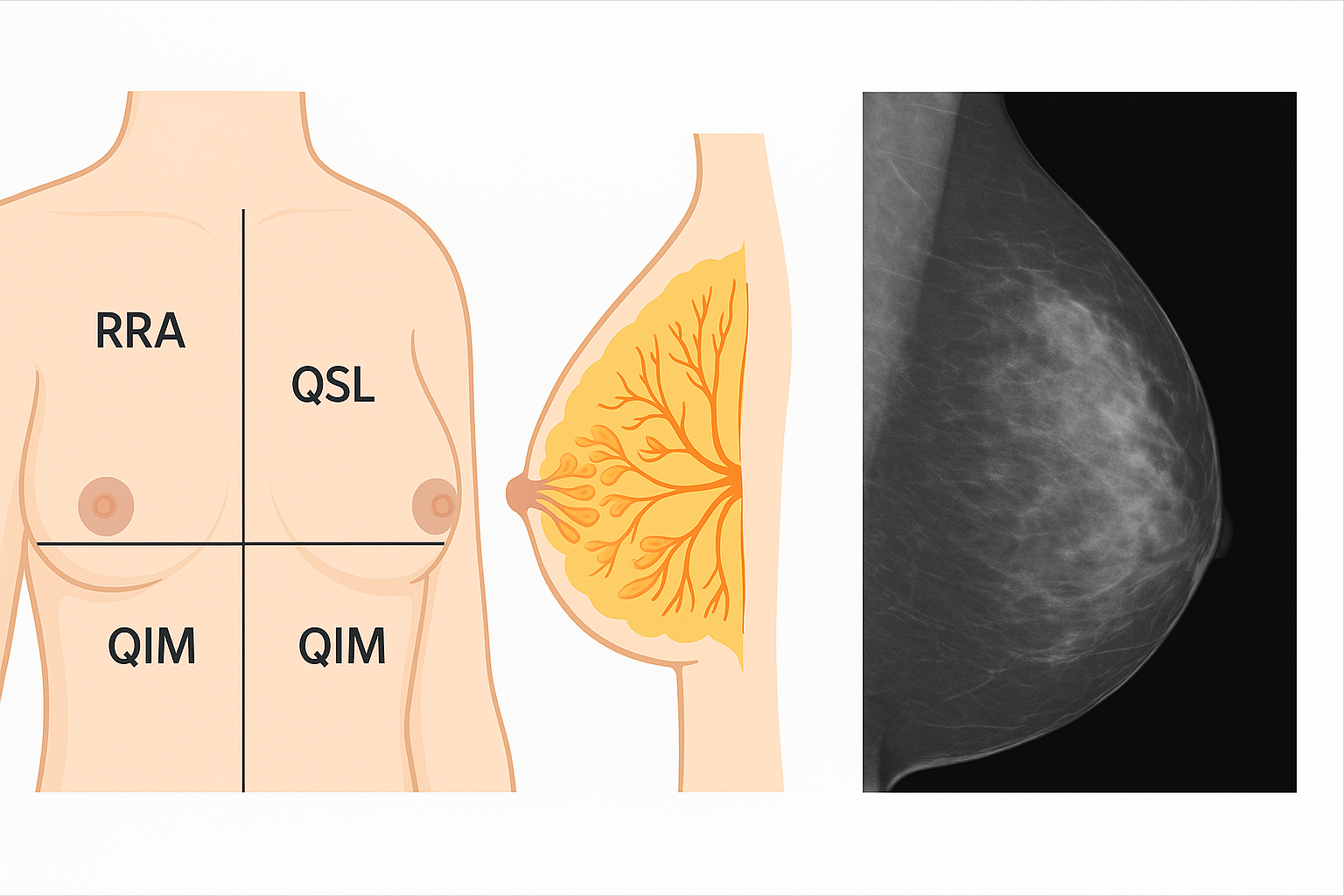
In mammogram reports, it is common to find acronyms like RRA, QSL, JQM, JQL, QIM, QIL, QSM, etc. These abbreviations correspond to specific areas of the breast, allowing the radiologist to precisely indicate where a finding — nodule, calcification, asymmetry — is located.
Thus, understanding these acronyms helps the patient and doctor correlate the report with the physical exam and other imaging (ultrasound, MRI).
- 🗺️ Acronyms like QSL, QIL, QSM, QIM indicate specific breast quadrants
- 🎯 Terms like RRA, RRL, RRM indicate radial depth near the nipple
- 🔄 Junctions like JQL or JQM indicate boundary areas between quadrants
- 📊 The report also uses the BI‑RADS classification for risk and recommendation
- 📌 Requesting illustrations in the report can make the results more understandable for you
Basic glossary of mammography terms
Breast parenchyma / Breast composition
Classification according to BI‑RADS: A (fatty), B (scattered), C (dense), D (extremely dense). However, dense breasts make it difficult to visualize lesions.
Nodule / Mass
Rounded or oval lesion with specific characteristics. Thus, spiculated or irregular aspects raise suspicion of malignancy.
Calcifications
Can therefore be benign or suspicious, depending on their shape, distribution, and grouping.
Asymmetry
Difference in density compared to the contralateral breast. It can therefore be focal, global, or developing.
Architectural distortion
Alteration of breast architecture without a defined mass. It can therefore indicate a suspicious lesion.
Other terms
- Skin thickening: inflammations or advanced tumors
- Nipple retraction: inverted or pulled nipple
- Intramammary lymph node: generally benign
- Cyst: liquid content, common and benign
- Fibroadenoma: benign solid tumor
- Lipoma: benign fatty tumor
Mammogram acronyms. Anatomical location codes (RRA, QSL, JQM etc.)
Breast quadrants (Q)
| Acronym | Meaning |
|---|---|
| QSL | Upper-Outer Quadrant |
| QIL | Lower-Outer Quadrant |
| QSM | Upper-Inner Quadrant |
| QIM | Lower-Inner Quadrant |
Retromamillary regions
| Acronym | Meaning |
|---|---|
| RRA | Retroareolar Retromamillary Region |
| RRM | Medial Retromamillary Region |
| RRL | Lateral Retromamillary Region |
Junctions between quadrants
| Acronym | Meaning |
|---|---|
| JQL | Junction of Lateral Quadrants |
| JQM | Junction of Medial Quadrants |
Practical example
“Spiculated image in the QSL of the left breast, in RRL topography, visible in CC and MLO incidences.”
This therefore indicates: upper outer part, lateral region behind the nipple, confirmed in the two main projections.
Frequently Asked Questions
1- What does QSL mean in a mammogram report?
QSL stands for Upper-Outer Quadrant, meaning the upper and outer part of the breast.
2- What is RRA in mammography?
RRA indicates Retroareolar Retromamillary Region, meaning the region behind the nipple.
3. What is BI-RADS and what is its purpose?
It is a standardized classification that indicates the degree of suspicion of mammographic findings and guides medical conduct.
4. What are microcalcifications?
These are small calcium deposits in the breast that can be benign or indicate early cancer, depending on their shape and distribution.
5. Does mammography hurt?
It can cause discomfort, but it is not usually painful. Compression is brief and necessary for image quality.
6. Can I have a mammogram with an implant?
Yes. There are specific techniques for patients with breast implants, such as the Eklund maneuver.
7. Does mammography detect all types of cancer?
It is effective for many types, but tumors in dense breasts may be less visible. Therefore, it is sometimes necessary to supplement with ultrasound or MRI.
8. What is architectural distortion?
It is an alteration of the breast structure that can indicate a malignant lesion even without a visible nodule.
9. What does asymmetry mean in the report?
It means that an area of one breast appears different from the corresponding area in the other breast. It can be benign or indicate something that warrants investigation.
10. How to interpret JQL or JQM?
These acronyms indicate junctions between quadrants — lateral or medial — suggesting that the finding is in an area of anatomical transition.
Related articles



Agendar consulta
Precisa de orientação personalizada?
Marque uma avaliação com o Dr. Fernando Amato e tire as suas dúvidas sobre cirurgia plástica.
Falar no WhatsApp