What is a seroma after abdominoplasty?
A seroma is the accumulation of fluid between the skin and fat flap and the abdominal wall following surgical undermining. Small fluid collections may be reabsorbed; others cause swelling, discomfort, and the need for medical evaluation.
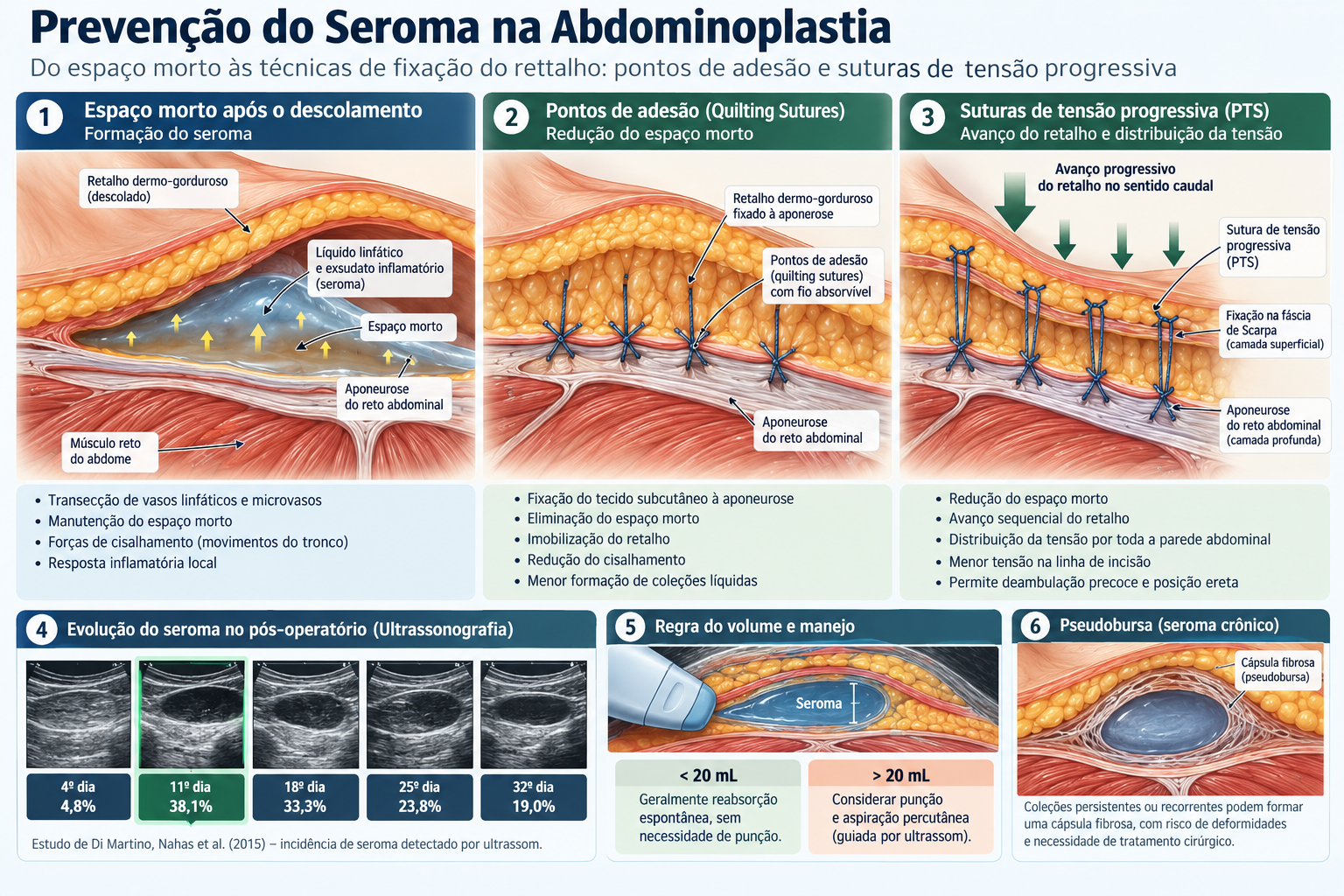
Prevention relies on strategies to reduce dead space (the cavity created by undermining) and shearing (sliding between tissue layers). These include quilting sutures, progressive tension sutures, and, in selected cases, the preservation of Scarpa's fascia.
Why does a seroma occur?
Its formation is multifactorial:
- Disruption of lymphatic vessels and microvessels: promotes fluid leakage into the surgical site.
- Dead space: allows fluid to accumulate between the flap and the aponeurosis.
- Tissue movement: breathing and torso movements generate shear forces and can impair initial adherence.
- Inflammation: surgical trauma temporarily increases vascular permeability.
The extent of undermining, surgical technique, and patient characteristics influence these mechanisms. Not all factors traditionally considered risk factors show consistent findings in research.
What are adhesion sutures (quilting sutures)?
These are sutures that anchor the subcutaneous tissue of the flap to the aponeurosis, a fibrous layer supporting the abdominal musculature. Their distribution across the abdomen decreases dead space and tissue mobility, reducing the conditions favorable to seroma formation.
Baroudi and Ferreira introduced this approach in a 1998 publication, reporting their clinical experience in seroma prevention. The principle is to address the formation of the fluid collection rather than simply evacuating the fluid after it accumulates.
What are progressive tension sutures?
Progressive tension sutures (PTS), described by Pollock and Pollock in 2000, sequentially anchor the flap as it is advanced toward the pubis.
PTS and quilting sutures share two mechanisms: reduction of dead space and reduction of shear forces. PTS further emphasize distributing tension along the abdominal wall rather than concentrating it at the suprapubic incision.
These techniques do not guarantee the absence of wound dehiscence, necrosis, or other complications; their selection must consider patient anatomy and surgical planning.
What is the evidence for seroma prevention?
Nahas, Ferreira, and Ghelfond (2007) studied 21 women who underwent abdominoplasty with quilting sutures. Ultrasound evaluation between postoperative days 15 and 18 showed a mean fluid volume of 8.2 mL per patient. Two patients required aspiration according to the study criteria. The small sample size and lack of a control group limit generalizability.
A systematic review by Liao and colleagues (2024), comprising 20 studies, found evidence supporting quilting sutures, progressive tension sutures, and preservation of Scarpa's fascia under specific circumstances. A 2026 review involving 30 studies and 16,280 patients also associated dead-space reduction strategies with a lower frequency of seroma.
The body of evidence is favorable, but does not demonstrate zero risk.
When does seroma typically appear?
Di Martino, Nahas, and colleagues (2015) monitored 21 patients using ultrasound on different days following abdominoplasty:
| Postoperative Day | Seroma detected by ultrasound |
|---|---|
| Day 4 | 4.8% |
| Day 11 | 38.1% |
| Day 18 | 33.3% |
| Day 25 | 23.8% |
| Day 32 | 19.0% |
In the sample, peak detection occurred on day 11, with collections being more frequent in the lower regions of the abdomen. This does not mean that all patients follow the same clinical course.
Should every seroma be aspirated?
No. The decision depends on symptoms, volume, progression, impact on tissues, and suspicion of infection. Small, asymptomatic collections can be monitored. Others may require aspiration, potentially ultrasound-guided.
The 20 mL threshold used in some studies is not a universal indication for aspiration. Treatment must be individualized.
What is a pseudobursa?
Persistent or recurrent collections can develop a fibrous capsule around the fluid, called a pseudobursa. It can sustain a bulge and hinder spontaneous resolution. There is no universal, fixed timeline for its formation. Chronic cases may require additional treatments, including surgery in selected situations.
Is it possible to perform abdominoplasty without drains?
Yes, in selected cases and with appropriate techniques. Suction drains remove fluid, but they do not eliminate dead space. Quilting sutures and progressive tension sutures (PTS) can reduce the need for drainage.
Pollock and Pollock (2012) reported a retrospective series of 597 abdominoplasties using progressive tension sutures without drains, with a low incidence of seroma. Selection and follow-up limitations must be considered.
Bercial and colleagues (2012) compared drains, quilting sutures, and fibrin glue in 43 patients. The results did not establish a statistically significant superiority of quilting sutures over drains. Subsequent reviews found results favorable to PTS, but recommend additional studies.
Therefore, drainless abdominoplasty is a technical option, not a mandatory rule.
Research by Dr. Fernando Amato: quilting sutures and drains in gynecomastia
The principle of dead-space reduction has also been evaluated in other anatomical regions.
In 2025, Amato FCM and colleagues published the randomized clinical trial “Quilting Sutures and Suction Drains in Preventing Postoperative Complications in Gynecomastia Surgery” in the journal Aesthetic Plastic Surgery [10].
The study compared 38 patients undergoing gynecomastia correction: 20 treated with quilting sutures and 18 with suction drains. Clinical and ultrasound evaluations were performed.
| Outcome | Quilting sutures | Drains |
|---|---|---|
| Patients | 20 | 18 |
| Fluid collections | 8 | 5 |
| Frequency | 40% | 28% |
The difference between the groups was not statistically significant. No patient required reoperation due to hematoma or seroma.
The study contributes randomized evidence, but it did not demonstrate the superiority of quilting sutures over drains. Because the research was conducted in gynecomastia surgery, its findings should not be automatically extrapolated to the abdomen.
Original article: https://doi.org/10.1007/s00266-025-04893-x
Can preservation of Scarpa's fascia help?
Scarpa's fascia is a membranous layer of the lower abdominal subcutaneous tissue. Its preservation, when appropriate, can reduce injury to lymphatic structures and undermining trauma. Some reviews find an association with a lower risk of seroma, but the technique depends on individual patient characteristics and the specific operation.
How to recognize a seroma and when to seek medical evaluation?
A seroma can cause swelling, asymmetry, a fluid sensation (fluctuance), and discomfort. Clinical examination and ultrasonography can confirm the diagnosis.
Fever, progressive redness, localized warmth, drainage, or significant pain require medical evaluation. Shortness of breath and relevant systemic symptoms demand urgent medical attention to rule out other complications.
Following surgery, it is important to adhere to guidelines regarding mobilization, dressings, compression garments when indicated, and follow-up visits. Early ambulation is part of many recovery protocols, with intensity tailored to the surgical technique and clinical status.
Conclusion
Quilting sutures and progressive tension sutures address the mechanisms of seroma formation, primarily dead space and shear forces. Selective undermining and the preservation of lymphatic structures can complement prevention.
Available research, including the clinical trial by Amato and colleagues on gynecomastia, underscores the importance of comparing techniques without presuming that a single solution is superior for all patients.
The best strategy combines surgical planning, individualized assessment, and meticulous postoperative care.
Scientific references
- Baroudi R, Ferreira CAA. Seroma: how to avoid it and how to treat it. Aesthetic Surgery Journal. 1998;18(6):439–441. https://doi.org/10.1016/S1090-820X(98)70073-1
- Pollock H, Pollock T. Progressive tension sutures: a technique to reduce local complications in abdominoplasty. Plastic and Reconstructive Surgery. 2000;105(7):2583–2586. https://doi.org/10.1097/00006534-200006000-00047
- Nahas FX, Ferreira LM, Ghelfond C. Does quilting suture prevent seroma in abdominoplasty? Plastic and Reconstructive Surgery. 2007;119(3):1060–1064. https://doi.org/10.1097/01.prs.0000242493.11655.68
- Bercial ME, Sabino Neto M, Calil JA, Rossetto LA, Ferreira LM. Suction drains, quilting sutures, and fibrin sealant in the prevention of seroma formation in abdominoplasty: which is the best strategy? Aesthetic Plastic Surgery. 2012;36(2):370–373. https://doi.org/10.1007/s00266-011-9807-8
- Pollock TA, Pollock H. Progressive tension sutures in abdominoplasty: a review of 597 consecutive cases. Aesthetic Surgery Journal. 2012;32(6):729–742. https://doi.org/10.1177/1090820X12452294
- Di Martino M, Nahas FX, Kimura AK, Sallum N, Ferreira LM. Natural evolution of seroma in abdominoplasty. Plastic and Reconstructive Surgery. 2015;135(4):691e–698e. https://doi.org/10.1097/PRS.0000000000001122
- Liao CD, Zhao K, Nikkhahmanesh N, Bui DT. Decreasing Seroma Incidence Following Abdominoplasty: A Systematic Review and Meta-Analysis of High-Quality Evidence. Aesthetic Surgery Journal Open Forum. 2024;6:ojae016. https://doi.org/10.1093/asjof/ojae016
- Rao G, Daneshi K, Ceccaroni A, et al. A Systematic Review and Meta-Analysis Evaluating the Surgical Outcomes of Progressive Tension Suturing Compared to Drains in Abdominoplasty Surgery. Aesthetic Surgery Journal. 2025;45(1):71–83. https://doi.org/10.1093/asj/sjae171
- Najafi K, Rasti N, Jojani M, et al. Risk factors for seroma formation following abdominoplasty: a systematic review and meta-analysis. Langenbeck's Archives of Surgery. 2026. https://doi.org/10.1007/s00423-026-04311-z
- Amato FCM, Sabino Neto M, Trincado MM, Lima PMGP, Aivazoglou LU, Velloni FG, Felix GAA, Ferreira LM. Quilting Sutures and Suction Drains in Preventing Postoperative Complications in Gynecomastia Surgery. Aesthetic Plastic Surgery. 2025;49(17):4901–4907. https://doi.org/10.1007/s00266-025-04893-x
Dr. Fernando Amato
Plastic Surgeon — CRM-SP 133826 | RQE 51573 | RQE 51436
https://plastico.pro
Agendar consulta
Precisa de orientação personalizada?
Marque uma avaliação com o Dr. Fernando Amato e tire as suas dúvidas sobre cirurgia plástica.
Falar no WhatsApp