
- Plastic surgery
Lipolaser and Other Technologies: Comparison and Medical Indications
- August 19, 2025
- By Fernando Amato
Fibrosis after liposuction? Lipolaser, combined with technologies like Vaser and BodyTite, can transform your results.
The evolution of technologies applied to liposuction has expanded the possibilities for surgical refinement, safety, and recovery.
Among these tools, lipolaser holds a special place. Although not the latest innovation, it still offers relevant clinical benefits — especially in secondary liposuctions to release fibrosis and adhesions and optimize body contour.
Throughout this article, we will explore the lipolaser wavelengths (1470 nm, 980 nm, and 1210 nm), its functioning, indications, and limitations, as well as compare it to technologies such as Vaser, BodyTite, Quantum, Morpheus, Argoplasma, and Renuvion.
Highlights
- 🔬 Three main wavelengths for specific approaches: 1470, 980, and 1210 nm
- 🩹 Special indication in secondary cases to treat post-lipo fibrosis
- ⚙ Comparison with modern assisted liposuction technologies
- 📈 Potential for skin retraction and body contour refinement
- 🩺 Surgeon's personal preference for complex adhesion cases
How Lipolaser works
Lipolaser is a laser-assisted liposuction technique that uses an optical fiber inserted through a thin cannula. Thus, light energy is converted into heat, acting in two main ways:
- Lipolysis — breakdown of fat cells (adipocytes), facilitating their aspiration.
- Coagulation — sealing of small blood vessels, reducing bleeding.
Wavelengths
- 1470 nm: directed penetration into collagen and water, generating more pronounced skin retraction.
- 980 nm: excellent for vessel coagulation, increasing hemostatic safety.
- 1210 nm (One Step): preferential absorption by fat, facilitating emulsification, preserving fat for fat grafting.
Each wavelength can be used alone or in combination, depending on surgical need.
Advantages of Lipolaser
- Less intraoperative bleeding due to vessel coagulation.
- Moderate skin retraction without the need for large incisions.
- Selective action on fat and collagen, depending on the wavelength.
- Special utility in secondary cases, where fibrosis and adhesions make tissue dissection difficult.
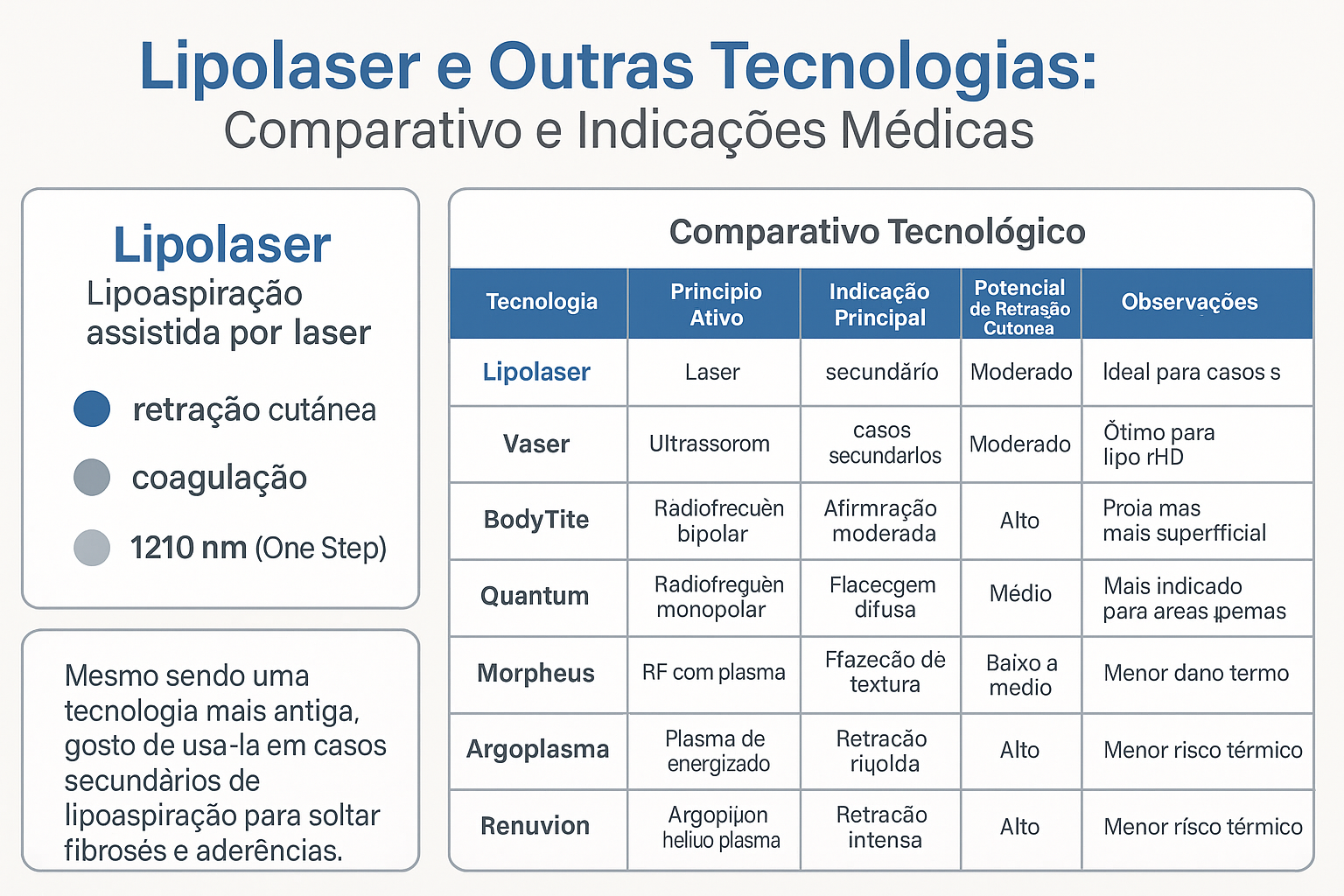
Comparison with Other Technologies
| Technology | Active Principle | Main Indication | Skin Retraction Potential | Notes |
|---|---|---|---|---|
| Lipolaser | Laser (1470, 980, 1210 nm) | Fibrosis, moderate retraction | Moderate | Ideal for secondary cases |
| Vaser | Ultrasound | High definition, preserves structures | Moderate | Great for HD lipo |
| BodyTite | Bipolar Radiofrequency | Moderate laxity | High | Intense and uniform retraction |
| Quantum | Monopolar Radiofrequency | Diffuse laxity | Medium | More superficial action |
| Morpheus | Fractionated RF + microneedles | Skin laxity and texture | Low to medium | More indicated for small areas |
| Argoplasma | Helium plasma | Rapid retraction | High | Less thermal damage |
| Renuvion | Energized helium plasma | Intense retraction | High | Associated with lower thermal risk |
Medical Indications
Lipolaser is indicated for:
- Primary liposuctions in small to moderate areas.
- Secondary liposuctions for the treatment of fibrosis and adhesions.
- Improvement of skin retraction in patients with mild laxity.
- Areas with delicate vascularization, such as the neck and arms.
Limitations
- Lower skin retraction capacity compared to BodyTite and Renuvion.
- Not the technology of choice for large volumes of fat.
- Requires specific training to avoid burns.
Internal Links
FAQ — schema.org/FAQPage
1. What is lipolaser?
Laser-assisted liposuction technology that emulsifies fat and promotes skin retraction.
2. What wavelengths are used?
1470 nm, 980 nm, and 1210 nm (One Step), each with a different action.
3. Does lipolaser replace Vaser?
No. They are complementary technologies, with distinct principles and indications.
4. Is it indicated for treating fibrosis?
Yes, especially in secondary liposuction cases.
5. Is there a risk of burns?
Yes, if the correct technique and temperature control are not used.
6. Is the result immediate?
There is initial improvement, but the final result appears within 6 months.
7. Is it more expensive than traditional lipo?
Generally yes, due to equipment cost.
8. Does it require general anesthesia?
Depends on the treated area; it can be local, epidural, or general.
9. Can it be performed on anyone?
No. There are contraindications, such as coagulation problems and active infections.
10. Can lipolaser be combined with other technologies?
Yes, including Vaser and BodyTite, to optimize results.
Related articles



Agendar consulta
Precisa de orientação personalizada?
Marque uma avaliação com o Dr. Fernando Amato e tire as suas dúvidas sobre cirurgia plástica.
Falar no WhatsApp