
- Diseases
Understanding SKIN Lesions: What they are and when to worry
- May 2, 2024
- By Fernando Amato
Discover everything about benign skin lesions, identify their risks, and learn how to effectively manage your dermatological health
- 🔍 Prevention: Monitor skin lesions regularly for early detection of changes.
- 🛡️ Care: Sun protection is crucial to prevent UV-induced lesions.
- 🧬 Self-examination: Learn to identify suspicious lesions and when to consult a dermatologist.
- 🏥 Medical Consultation: Visit a dermatologist regularly for skin exams, especially if you have atypical lesions.
- 📘 Education: Understanding the characteristics of benign lesions can reduce anxiety related to spots and moles.
🔍 Introduction:
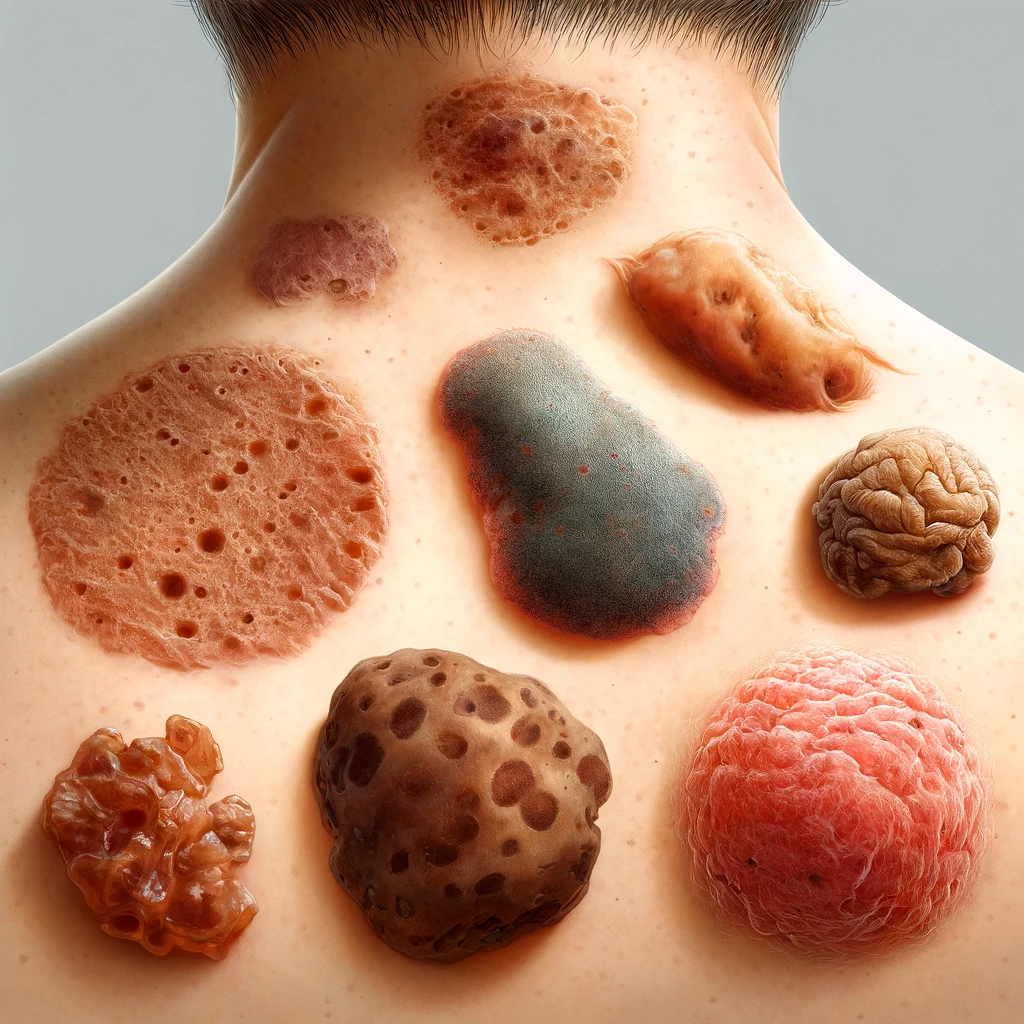
In the vast dermatological universe, benign skin lesions represent a wide range of conditions that, although generally not harmful, can cause aesthetic concerns or discomfort. This text, therefore, aims to clarify the characteristics of these lesions, explaining which are completely benign and which require continuous monitoring due to their potential for malignant transformation.
🔬 Main Types of Benign Skin Lesions
1. Junctional Nevus
- Description: Flat and smooth lesion with irregular coloring. It appears at any age, but is more common in children and young adults.
- Location: Can appear on any part of the body.
- Malignant potential: No.
2. Compound Nevus
- Description: Darker, raised, and rough, often with hair. However, it tends to appear in puberty and may increase with age.
- Malignant potential: No.
3. Atypical or Dysplastic Nevus
- Description: Acquired, asymmetric, and irregular lesions with varied colors, usually larger than 6mm, mainly found on the back.
- Malignant potential: Yes.
4. Benign Juvenile Melanoma (Spitz Nevus)
- Description: Generally unpigmented, thus, it presents a pinkish color with brown spots and a papular texture. More common on the face before puberty.
- Malignant potential: No.
5. Congenital Nevus
- Description: Present at birth or in the first year of life. It then usually appears on the head or pelvis with a brown to black color and irregular borders.
- Malignant potential: Yes.
🌞 Skin Lesions Induced by Sun Exposure
1. Solar Lentigo
- Description: Smooth, brown-black lesion, can reach up to 15cm. Common in the elderly in sun-exposed areas.
- Malignant potential: No.
2. Actinic Keratosis
- Description: Multiple flat, hyperkeratotic lesions with an erythematous base. Located in sun-exposed areas.
- Malignant potential: Yes.
Frequently Asked Questions
- What does it mean for a lesion to be benign?
- A benign lesion, however, is a non-cancerous skin change that generally is not life-threatening. Nevertheless, some may require monitoring due to their potential for malignant transformation.
- How can I differentiate between a benign nevus and a suspicious lesion?
- Benign lesions tend to have regular borders and uniform coloring. Suspicious lesions may change color, shape, or size and may bleed or itch. Therefore, if in doubt, always consult a dermatologist.
- Which benign skin lesions have the potential to become malignant?
- Lesions such as atypical nevus, congenital nevus, and actinic keratosis have a higher risk of malignant transformation and should be monitored regularly.
- What is the importance of sun protection for benign lesions?
- Sun protection, therefore, is vital for preventing sun-induced lesions, such as lentigines and actinic keratoses, and can help minimize changes in existing lesions.
- Should I remove a benign lesion?
- Removal is recommended if the lesion causes discomfort, pain, or for aesthetic reasons. Some lesions with malignant potential may also be removed as a preventive measure.
#BenignLesions #Dermatology #SkinCare #Prevention #SkinHealth
Share this article:
Related articles



Agendar consulta
Precisa de orientação personalizada?
Marque uma avaliação com o Dr. Fernando Amato e tire as suas dúvidas sobre cirurgia plástica.
Falar no WhatsApp