Scars don't disappear — scars are remodeled. Fractional CO₂ laser is currently the tool with the best evidence for making surgical, atrophic, and (in protocol) hypertrophic scars closer to the surrounding skin. Results in color, texture, and thickness — not in "erasing".
First of all: what type of scar is this?
| Type | Appearance | Response to CO₂ |
|---|---|---|
| Atrophic (depressed) | Sunken, "hole" | Excellent — stimulates collagen and evens out |
| Hypertrophic | Raised but confined to the original scar | Good, in combined protocol with corticosteroid |
| Keloid | Grows beyond the original scar, may itch/hurt | Only in combined protocol — isolated can worsen |
| Dyschromic (stain) | Color difference with surrounding skin | Good — lightens hyperpigmentation, stimulates repigmentation |
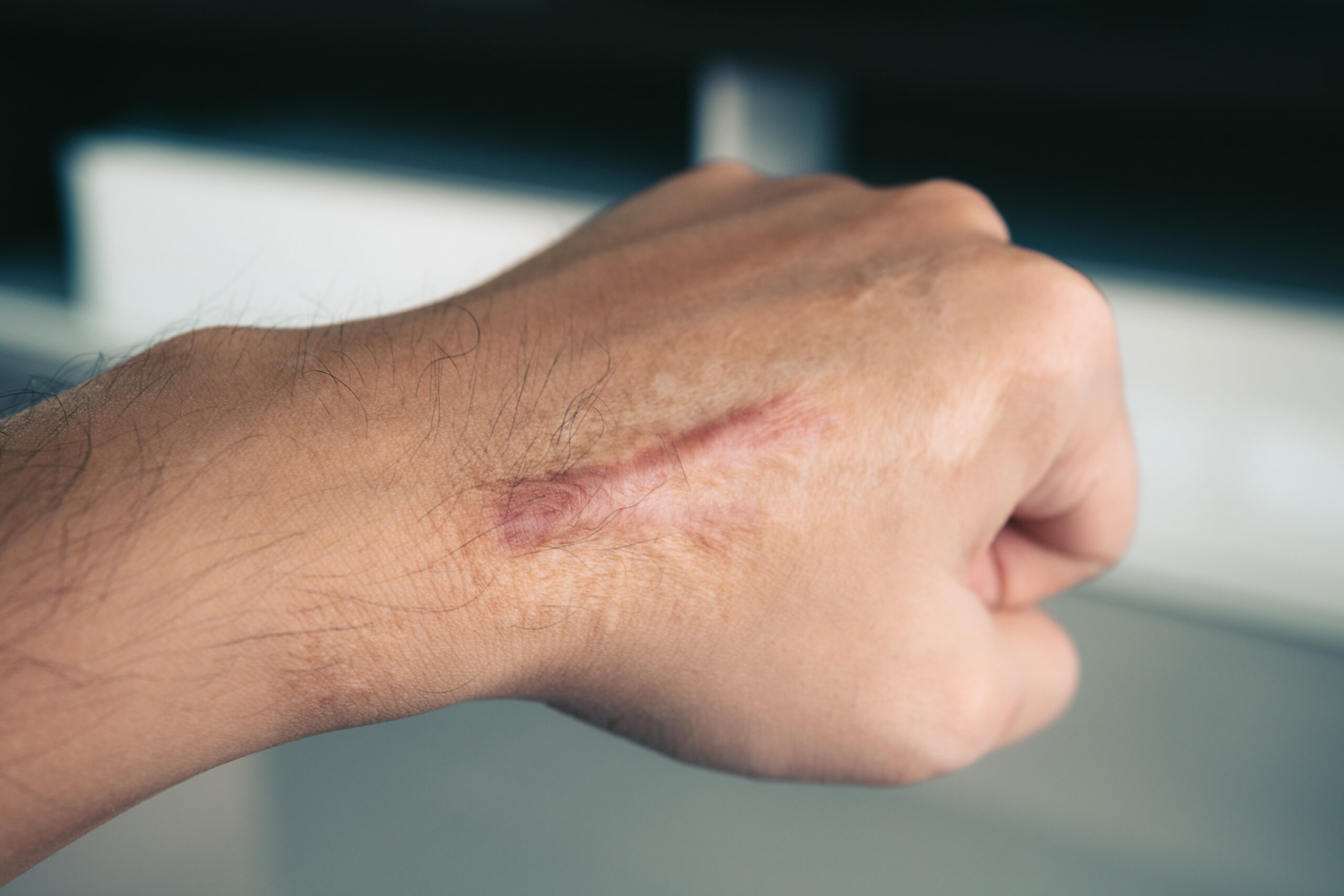
| Linear hypertrophic (old surgical) | Hardened, red or whitish line | Excellent — thins, softens color, improves texture |
How the CO₂ laser acts on scars
The laser emits micro-columns of light (fractional mode) that evaporate microscopic zones of scar tissue. The skin around the columns remains intact — these "islands" heal quickly and organize new collagen, more similar to healthy tissue. In parallel, the laser's heat breaks down disorganized fibers. In depressed scars, the stimulation of new collagen fills the step; in raised scars, it thins and softens the tissue.
When to start treatment
- Recent surgical scar — usually after 60–90 days, when the tissue is closed and stable
- Scar with hypertrophic tendency — can start from 30 days with light parameters
- Old scar — it's never "too late"; even scars years old respond
- Post-acne scar — after active acne control and outside the post-Roacutan window
Typical session for scars
- Topical anesthesia 45 min before
- Shots focused on the scar + 2–3 mm margin
- In hypertrophic cases: corticosteroid (triamcinolone) infiltration in the same session
- Session lasts 10 to 30 min, depending on the area
- Post: redness and thin crusts for 5–10 days
Combined protocols (when CO₂ alone is not enough)
- Hypertrophic scar: CO₂ + intralesional corticosteroid + topical silicone (sheet/gel) between sessions
- Keloid: CO₂ + corticosteroid ± 5-FU + silicone + long-term follow-up
- Depressed scar on dark skin: mild CO₂ + microneedling between sessions + topical lightening agent
- Atrophic acne scar: CO₂ + subcision (release of fibrous bands) + filler in selected cases
Realistic expectations
- 40 to 70% improvement in series of 3–5 sessions in well-indicated cases
- Scar does NOT disappear — it becomes closer to the surrounding skin
- Result is progressive — evaluated 60–90 days after each session
- Maintenance: 1 annual session helps with scars that tend to "thicken"
Frequently Asked Questions
Does CO₂ laser remove scars?
Scars do not disappear — they are remodeled. Fractional CO₂ laser breaks down disorganized collagen fibers and stimulates remodeling, making the scar closer to the surrounding skin in color, texture, and thickness. Improvement is typically 40 to 70% in well-indicated cases.
How many sessions are needed to treat a scar with CO₂?
On average 3 to 5 sessions spaced 30–60 days. Older and atrophic (depressed) scars respond more slowly. Hypertrophic and keloid scars require a combined protocol with corticosteroid infiltration.
When to start laser after surgery?
The scar must be closed and stable — usually after 60 to 90 days. For recent scars showing a hypertrophic tendency, treatment can start earlier (from 30 days) with light parameters, under supervision.
Does it work on keloids?
Not alone — in active keloids, isolated CO₂ laser can worsen them. It works in a COMBINED PROTOCOL: corticosteroid infiltration (with or without 5-FU) + fractional laser in spaced sessions. Dermatological/plastic evaluation defines the protocol.
Who cannot undergo treatment?
Patients who have recently used isotretinoin (Roacutan) — wait 6 months, pregnant women, active skin infections, active herpes in the area. In phototypes IV–VI, parameter adjustment and prior lightening are required to avoid post-inflammatory hyperpigmentation.
Agendar consulta
Precisa de orientação personalizada?
Marque uma avaliação com o Dr. Fernando Amato e tire as suas dúvidas sobre cirurgia plástica.
Falar no WhatsApp