
- Plastic Surgery, Surgeries
Avoid Surprises: 7 Common Errors in Pre-Surgical Assessment
- January 5, 2026
- By Fernando Amato
Negligence in pre-operative assessment can compromise surgical success — understand the 7 most frequent errors and how to avoid them.
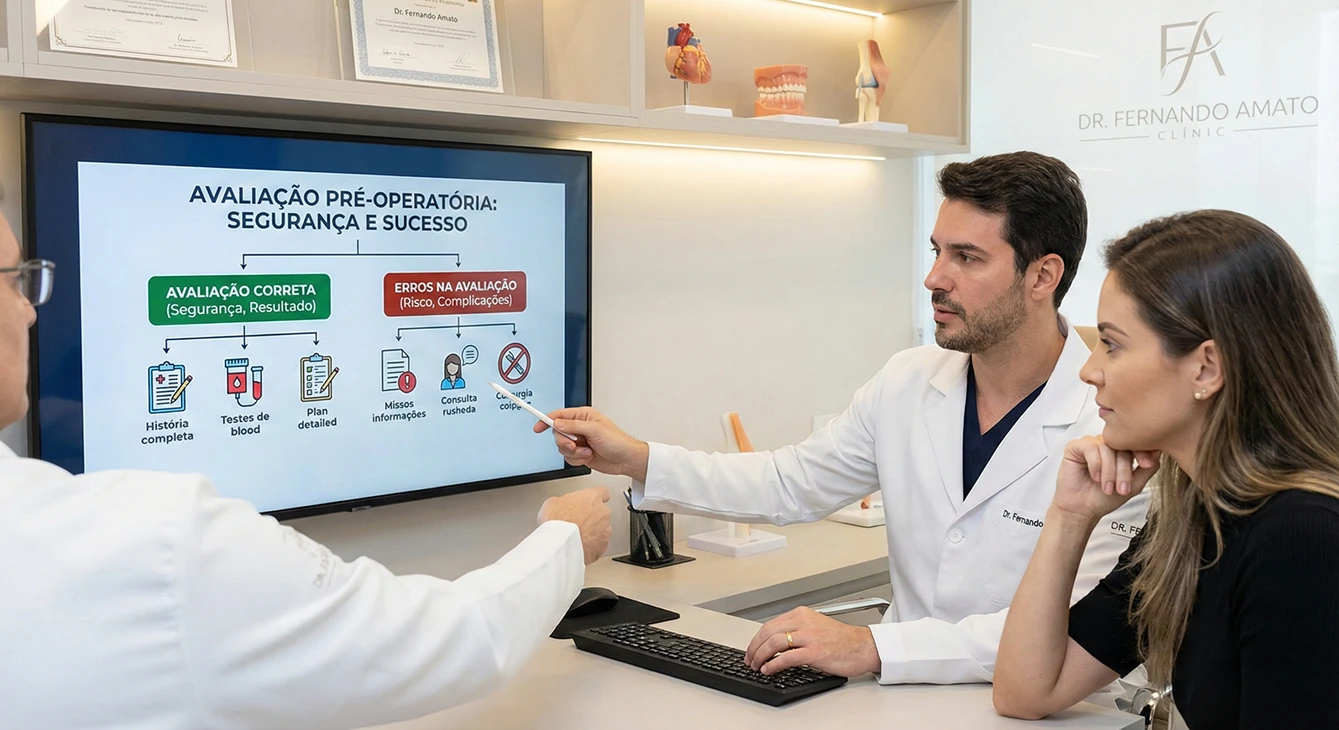
When it comes to plastic surgery or any elective surgical procedure, the pre-operative assessment phase plays a decisive role in its success and safety. A set of errors in pre-operative assessment can compromise not only the aesthetic or functional result, but also increase the risks of complications, delays, or cancellations. Therefore, it is essential that both the patient and the medical team are attentive, work together, and anticipate potential problems.
Below, I present the seven most common errors in pre-operative assessment — each with its explanation, consequences, and prevention recommendations.
⚠️ Error 1: Incomplete or superficial clinical history
A pre-operative assessment should therefore include a complete medical history: previous illnesses, medication use, allergies, smoking, alcohol consumption, coagulation disorders, anesthesia history, among others.
Therefore, when this step is neglected or superficial, the following risks arise:
- Surprises during anesthesia or intraoperative period (such as allergic reactions).
- Unoptimized diseases (hypertension, diabetes, obesity).
- Lack of specific preparation (stopping anticoagulants, adapting medication).
Recommendation: Talk to your doctor or surgeon: inform everything — including continuous use medications, supplements, lifestyle habits. Confirm that the history has been thoroughly reviewed.
⚠️ Error 2: Insufficient or inadequate physical examination
After the history, the physical examination should then assess the cardiovascular and respiratory systems, nutritional status, renal/hepatic function, airway (in case of general anesthesia), etc.
Common errors:
- Not assessing the airway (risk of difficult intubation).
- Ignoring signs of heart failure or hidden lung disease.
- Not recognizing frailty or malnutrition, which compromises recovery.
Recommendation: Ask if the surgeon or anesthesiologist has assessed these systems. If you have a history of “shortness of breath when climbing stairs,” “severe snoring,” “respiratory problems,” mention it explicitly.
⚠️ Error 3: Unnecessary or poorly directed laboratory tests/examinations
There are two problematic extremes: (a) ordering too many unnecessary tests for a healthy patient — which generates false positives — and (b) failing to order relevant tests for a patient with comorbidities. However, recent studies show that many pre-operative tests are performed without adequate scientific justification.
Consequences:
- Additional costs.
- Falsely altered results, leading to postponements.
- Lack of critical tests that would reveal increased risk.
Recommendation: Ask if the tests were “tailored” to your case, or a standard routine. A healthy patient without comorbidities does not require a complete, in-depth panel.
⚠️ Error 4: Underestimation of physiological or functional risk
Assessing only “age” or “disease” is not enough: it is necessary to estimate functional capacity (for example: “can you climb two flights of stairs without stopping?”) and the risk load associated with the procedure.
Errors:
- “The patient seems fine, so everything will go smoothly” — when there are unrecognized limitations.
- Not using indices or classifications that help predict complications.
Recommendation: Ask about tools used for risk (e.g., ASA scale, stress test, pulmonary evaluation). If your functional capacity is reduced, consider prior optimization.
⚠️ Error 5: Failure to optimize comorbidities before surgery
Having a disease such as diabetes, hypertension, obesity, renal or hepatic dysfunction requires optimization before surgery.
Common error: scheduling surgery with an unstable comorbidity. Result: increased risk, delayed healing, infections.
Recommendation: Therefore, check if the doctor recommended adequate control of blood glucose, blood pressure, organic functions — and if they considered postponing or adapting the surgery until these conditions are under control.
⚠️ Error 6: Neglecting lifestyle factors and post-operative support
Pre-operative assessment is not limited to examinations. Aspects such as smoking, alcohol consumption, nutrition, family support, and adherence to post-operative care are crucial. Studies show that smoking, for example, alters healing and increases the risk of thrombosis.
Errors:
- Not advising to stop smoking in advance.
- Ignoring excessive weight or malnutrition.
- Not assessing if the patient has support at home for post-operative care.
Recommendation: Ask explicitly about lifestyle preparation: quitting smoking, improving diet, mobility, family support. Confirm that the team has discussed this.
⚠️ Error 7: Lack of communication and complete informed consent
Pre-operative assessment also includes dialogue between the team and the patient — risks, benefits, alternatives, and what will be done in the operative plan. If this is flawed, the patient may not be truly prepared.
Errors:
- The patient does not fully understand what is being proposed.
- The need for postponement if conditions are not optimized is not informed.
- Lack of clarity about what occurs intra- and post-operatively.
Recommendation: Request a consultation where all risks are explained, ask: “What if my blood pressure/glucose is not okay, what happens?” and ensure your consent is informed.
🧭 Conclusion & CTA
Pre-operative assessment is the foundation of safe surgery and a satisfactory outcome. The “errors in pre-operative assessment” highlighted above are avoidable with preparation, dialogue, and attention.
If you are considering a procedure — be it Liposuction, Abdominoplasty, Mammoplasty or another — ensure your pre-operative assessment is complete.
👉 Schedule a consultation with your surgeon or anesthesiologist to carefully review each item of the assessment. Safety and outcome depend on this preparation.
📽️ Video
Related articles

Diet before and after plastic surgery

Healthy eating in post-operative plastic surgery
Agendar consulta
Precisa de orientação personalizada?
Marque uma avaliação com o Dr. Fernando Amato e tire as suas dúvidas sobre cirurgia plástica.
Falar no WhatsApp