Breast Asymmetry
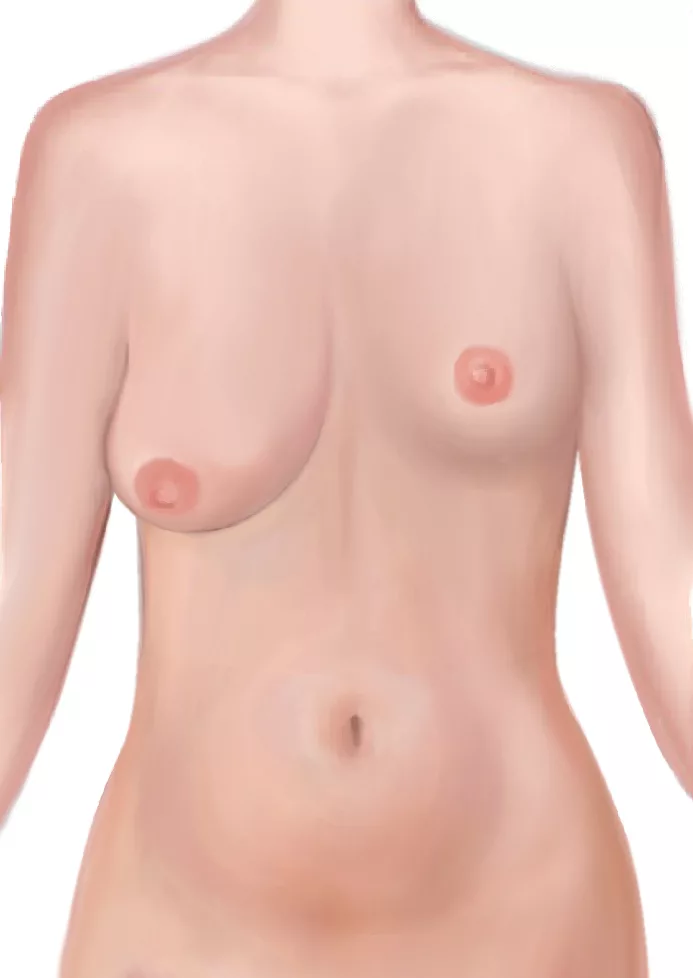
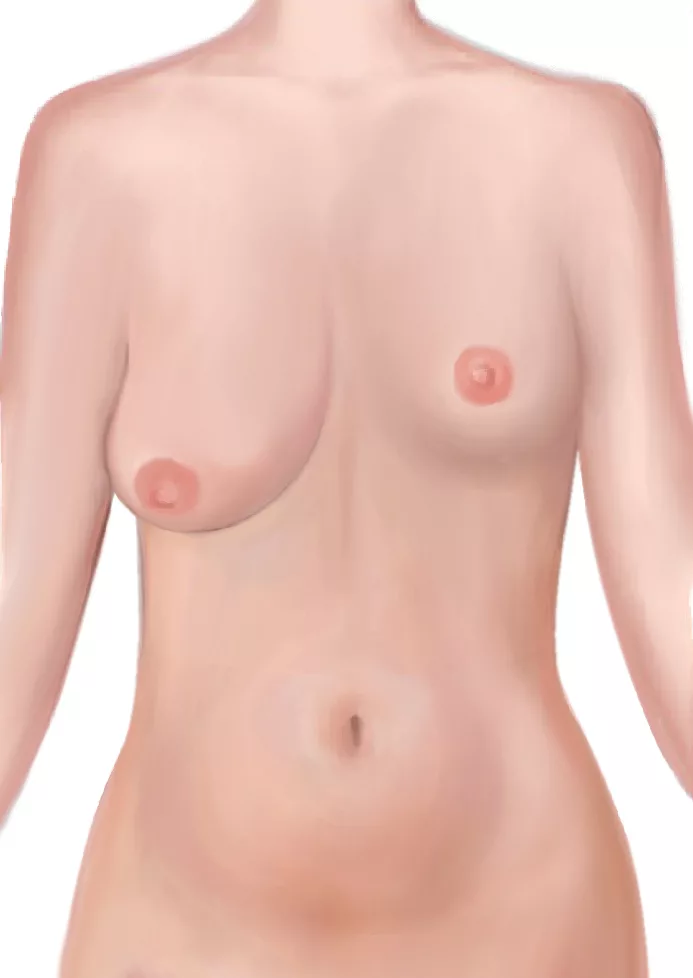
Breast asymmetry is a difference in size, shape, and volume between the breasts. It is very common for there to be some difference in women, even if subtle. Sometimes they are related to changes in posture or even spinal deformities like scoliosis.
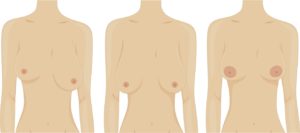
Almost all patients present with some difference.
Small differences are acceptable, but depending on the case, it can not only interfere with quality of life but can also worsen the patient's posture, leading to spinal complications.
Classification:
-
- Type 1: Unilateral hypomastia
-
- Type 2: Bilateral hypomastia with asymmetry
-
- Type 3: Unilateral mammary hypertrophy
-
- Type 4: Bilateral mammary hypertrophy with asymmetry
-
- Type 5: Unilateral hypomastia + Unilateral hypertrophy
- Type 6: Hypomastia + thoracic deformity
Treatment can vary according to each case but is mainly performed using techniques already employed in aesthetic breast surgeries and breast reconstruction. This can include breast augmentation with implants, mastopexy with or without prosthesis, reduction mammaplasty, in addition to the association of other techniques such as lipofilling (fat grafting).
To try to improve the result, it is already possible to predict the volume of implant placed or breast reduced using 3D simulators
 https://youtu.be/pt-_dG_Qo-k
Description
https://youtu.be/pt-_dG_Qo-k
Description
Breast Asymmetry is the difference between the breasts, whether in size, shape, or position. Treatment varies in each case, and can involve mammaplasty and mastopexy, with or without breast implants. Watch the video and see more details with Dr. Fernando Amato (CRM 133826).
TranscriptBreast asymmetry is the difference in size
between the breasts.
This difference can be very subtle, and it
is very common.
It can occur in almost all women,
at least with some asymmetry, which is
acceptable.
This asymmetry can even be associated
with a change in the patient's posture or
some spinal condition, such as scoliosis.
Small differences are acceptable, but
depending on the case, it can interfere with the patient's quality
of life or even lead to incorrect
posture, causing back pain,
spinal pain.
This asymmetry can present in various
forms, with several classifications, one
of which is type 1, when only one side is
small.
There's type 2, when both sides are small,
but one is smaller than the other.
It can present with hypertrophy, meaning
one side is very large and, therefore, might need
breast reduction, which can be unilateral hypertrophy,
meaning only one side.
This hypertrophy can also occur on both
sides with a very large difference.
Furthermore, there can be hypomastia, meaning
one undeveloped side and one very
developed side, and in rare cases, it can present
hypomastia, meaning a small breast
with some chest wall deformity.
Treatment will vary according to each
case.
So, in cases where the breast is small,
it can be done with only a prosthesis, it can be
done with fat grafting, and in large breasts
breast reduction, mammaplasty, can be done.
And there are cases that require repositioning
of the areola, which is mastopexy.
And this mastopexy can be done with or without
a breast prosthesis, the breast implant.
Current technology allows for the possibility
to predict a result or at least predict a
volume through 3D simulations, and I believe
that this is the future: being able to use
technology to assist in this correction
of volume between the breasts.
Did you like our video?
Follow us on our social media.
https://youtu.be/sbd1kGm1ia0 Description
In this video, Dr. Fernando Amato @Dr Fernando Amato, Plastic Surgeon at Instituto Amato, will talk about questions women have about breast surgery!
Breast augmentation? Breast reduction? Fat grafting? Hybrid mammaplasty? Mastopexy with implant? Mastopexy without implant? Anatomical implant? Conical? Round? Silicone prosthesis? Silicone implant? What is best for your health?
What are the complications? What are the risks?
A controversial topic worth discussing!!!
Get to know Dr. Fernando Amato's channel: https://www.youtube.com/channel/UCJ_9Ge8xH4mkfvYM2yk5k8Q
Check out the exclusive Plastic Surgery playlist on the channel:
Follow Dr. Fernando on Instagram: @meu.plastico.pro
Visit Dr. Fernando's Website: www.plastico.pro
Watch the recommended video on the CHANNEL right now: https://bio.amato.io/indicado
Watch this video about how to care for the drain in the postoperative period:
Also watch this video about Hematoma: https://www.youtube.com/watch?v=xY6sN1Fy-Ys
https://www.youtube.com/watch?v=56AaGlgVAAc&t=1s
If you want to have breast surgery
and have doubts about which procedure is
ideal: mammaplasty,
mastopexy, silicone implant placement,
fat grafting, what is the best
procedure for you, what are the
risks and benefits of a silicone implant,
what are the advantages of a silicone implant,
what is the difference between
silicone implants, what texture, what
shape, what is the ideal volume and size for
your case? Did you know that it is possible
to simulate the result of a mammaplasty?
In addition to a careful physical examination of the
patient's measurements, breast measurements,
evaluation of skin quality in a
consultation, by performing volume simulations
both with molds for the patient to feel
the desired volume and also, mainly, we perform
3D simulations.
One of the most modern tools
available to assist in choosing the ideal
breast implant, the ideal silicone prosthesis
for you, is a technology
primarily used for breasts with
breast asymmetries. It is done with a
camera with adapted lenses, and
the images are processed by specific software,
and with this, it is possible to visualize the
breasts in 3D on the computer, and thus
we perform the simulation,
testing various sizes, shapes, and
volumes.
For the patient to have this experience,
the patient can get an idea of how
the breast will look after the implant
placement, even before plastic surgery.
This is already a reality. Although it is not
a promise of result, this
technology greatly aids communication
between the patient and the plastic surgeon
regarding better understanding the
surgery and its possible results. The
doctor must respect the patient's wishes,
and this wish will serve as a guide
for choosing the ideal silicone prosthesis.
The ideal shape and volume for you. The doctor
should use good judgment and explain to the
patient which implant will provide the
best result, the most harmonious result. Note that the measurements of each
implant can vary greatly. For example,
the prosthesis can have the same base but
different projections, and will also have
different volumes.
I particularly like to present in the
consultation before surgery
different volumes and shapes for the
patient to pick up, feel, and understand the
difference between them. Another technique
can be adopted in the office is the use
of molds. The molds allow the
patient to try them in a bra and feel the
difference between different volumes.
It facilitates your choice. It is important to mention that
we also use molds during surgery,
but these molds serve to guide
the surgeon in choosing the best
implant. I particularly use molds
in surgery in cases where the patient
presents breast asymmetry,
facilitating the choice of implants of different
volumes. With 3D technology, it is increasingly
helping in plastic surgery,
helping the patient understand
the desired procedure.
I usually tell patients that the
surgery really begins at the time of the 3D simulation.
In addition to augmentation mammaplasty with
silicone implants, 3D technology can also
be used in surgical simulations
for other breast surgeries such as
breast reconstruction, fat grafting,
and correction of breast asymmetries.
We also use it for other regions
such as the face, abdomen, buttocks,
and other body regions. I like
this 3D technology for tracking the
postoperative evolution,
showing the differences from pre- to
postoperative, and we can even
monitor the postoperative evolution,
showing swelling reduction in the
first few days. If you liked this
technology, I am Dr. Fernando Amato,
plastic surgeon at Amato Institute, and I
look forward to seeing you there.
And then
Especialidade
Saiba mais sobre os procedimentos relacionados.
Agendar consulta
Precisa de orientação personalizada?
Marque uma avaliação com o Dr. Fernando Amato e tire as suas dúvidas sobre cirurgia plástica.
Falar no WhatsApp