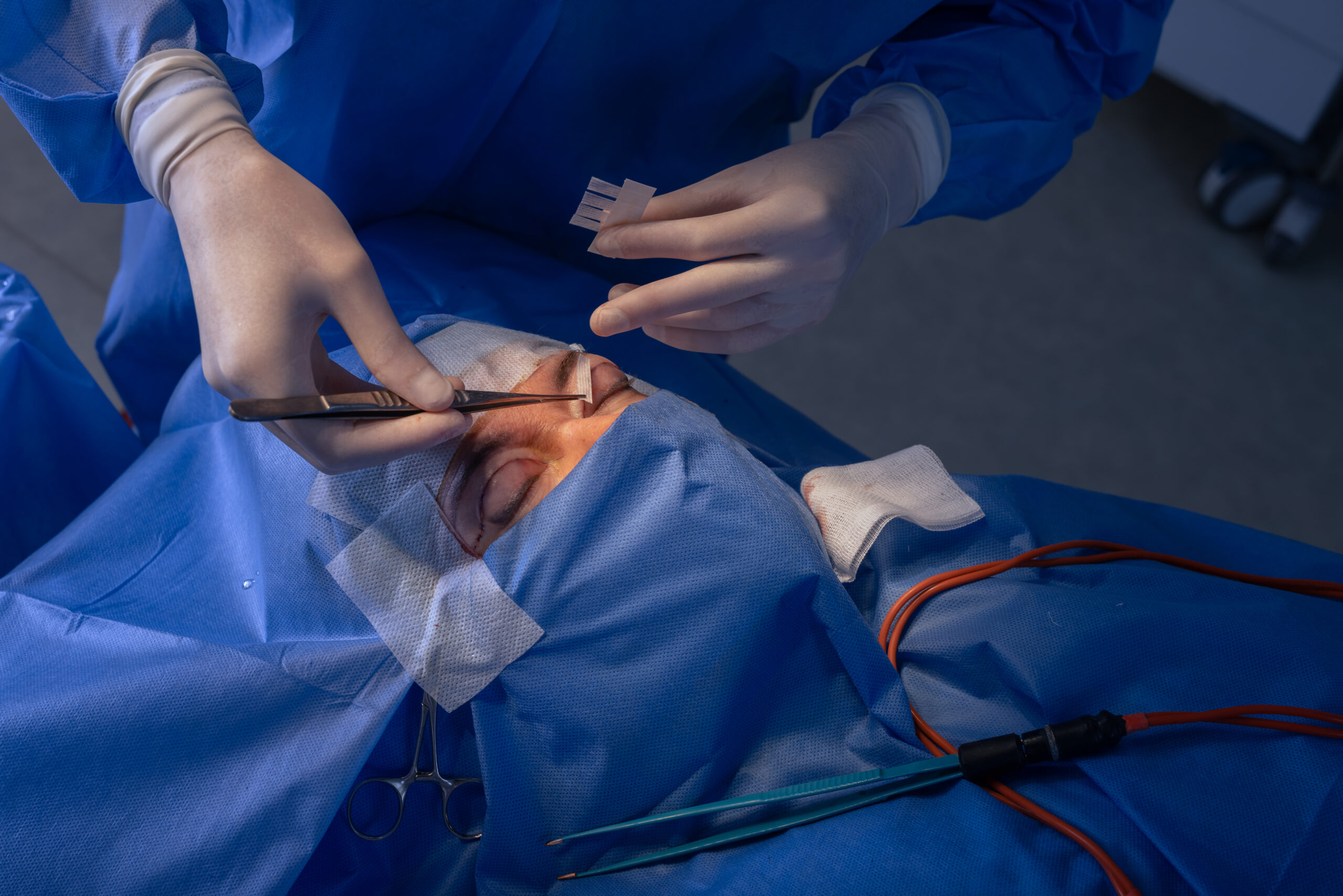
Searching for "CO₂ laser on eyelids before and after" shows a predictable pattern: improved texture, reduction of fine wrinkles, and lightening of blemishes. What doesn't appear in the photos is what the laser doesn't solve — and that's precisely what needs to be clear before deciding.
What visibly changes after laser on the eyelids
- More discreet crow's feet (dynamic and static fine wrinkles)
- Smoother texture, less apparent pores
- Skin with more luminosity and tone
- Lightened sun spots
- Subtle retraction of the superficial eyelid skin ("tightening" effect)
What the laser does NOT solve
- Actual excess upper eyelid skin (skin "hanging" over the lash line) — this requires surgery
- Lower fat bags — this requires surgery (frequently transconjunctival)
- Deep tear trough (under-eye hollow) — requires filler or fat grafting
- Eyelid ptosis (drooping eyelid due to muscle problem) — requires specific surgery
Common combinations (when it makes sense)
- CO₂ laser + blepharoplasty — remove skin and bags + refine texture and fine wrinkles in the same procedure
- CO₂ laser + filler — laser for texture/wrinkles, filler for tear trough
- CO₂ laser + botulinum toxin — laser for static texture, toxin for dynamic wrinkles
Realistic protocol for an isolated session
- Topical anesthesia 45 min before (cream)
- Metallic ocular protection (eye shield)
- Pulses across the entire periorbital area, adjusting intensity on the eyelid skin
- Calming mask and protector
- Expected recovery according to the schedule below
Day-to-day recovery (isolated periorbital laser)
- D0: redness, mild eyelid edema, sensation of sunburn
- D1–2: eyelid edema more visible in the morning, continuous hydration
- D3–5: fine peeling, sensation of a "crust" — do not pick
- D6–10: renewed skin, residual redness, makeup allowed
- D10–30: redness disappears, result consolidates
How to tell if it's a surgical or laser case
Simple test (for guidance only): with the patient looking straight ahead, gently push the eyebrow upwards. If the excess skin disappears, there is a component of eyebrow ptosis. If it persists, there is actual excess eyelid skin (probable surgical indication). Gently press the lower eyelid — if bags appear, it is herniated fat (surgery). In both cases, an in-person evaluation is what defines.
Frequently asked questions
What does CO₂ laser treat on the eyelids?
Crow's feet, fine peri-orbital wrinkles, uneven texture, sun spots in the area, and mild skin laxity of the eyelid skin. When there is significant excess skin or fat bags, laser alone is not enough — surgery (blepharoplasty) is indicated, possibly with combined resurfacing.
How many sessions does it take to see results?
One session of high-intensity fractional CO₂ already shows visible improvement in texture and fine wrinkles after 30–60 days. For more expressive results, 2 to 3 sessions are usually done, spaced 30–60 days apart. Collagen stimulation continues for ~90 days after each session.
What is the recovery like after laser on the eyelids?
Redness and eyelid edema for 3–5 days (more visible in the morning). Fine peeling between the 4th and 7th day. Social activities can be resumed in 7 days. Residual redness disappears in 2 to 4 weeks. Results consolidate in 60 to 90 days.
Does laser on the eyelids replace blepharoplasty?
It does not replace it when there is actual excess skin or fat bags. It partially replaces it in cases of mild laxity restricted to the superficial skin. An in-person evaluation determines whether the case is surgical, laser, or a combination.
Can it be done on patients with dark skin?
Yes, but with adjusted parameters, prior lightening (generally 2–4 weeks of hydroquinone), and a strict post-treatment protocol to prevent post-inflammatory hyperpigmentation. In higher phototypes, lighter and more spaced sessions are preferable.
Especialidade
Saiba mais sobre os procedimentos relacionados.
Agendar consulta
Precisa de orientação personalizada?
Marque uma avaliação com o Dr. Fernando Amato e tire as suas dúvidas sobre cirurgia plástica.
Falar no WhatsApp