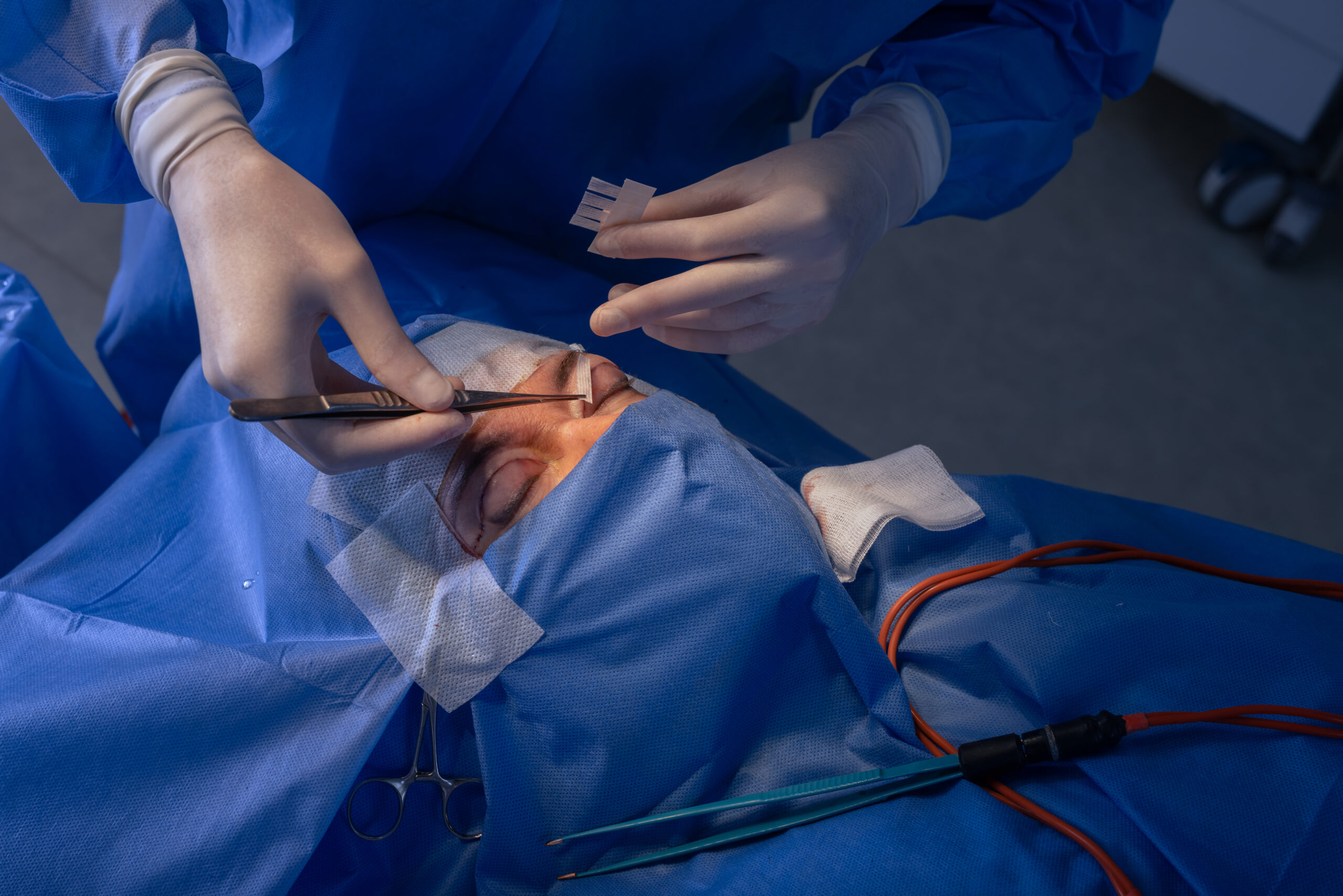
"Laser blepharoplasty" is a marketing term that often causes confusion. In practice, it means performing eyelid surgery with a CO₂ laser instead of a scalpel, or combining surgery with laser resurfacing to treat fine wrinkles and periorbital texture. It is not a "surgery without surgery" — it is the same blepharoplasty, with a better instrument for certain steps.
What changes when a laser is used in blepharoplasty
- Incision — the laser cuts and coagulates simultaneously. Less bleeding during the procedure, smaller hematoma post-operatively.
- Periorbital resurfacing — after completing the surgery, the same laser, in fractional mode, can treat crow's feet and surrounding skin texture.
- Transconjunctival approach — for fat bags without excess skin, the laser allows for an incision inside the eyelid (without an external scar).
When the laser offers a clear advantage
- Lower bags without significant excess skin (transconjunctival approach)
- Patients prone to hematoma (using anticoagulants, ASA, vitamin E)
- Combination of surgery + resurfacing to treat fine wrinkles in the same procedure
- Fair skin that tolerates resurfacing well
When it DOESN'T make much difference
- Simple upper blepharoplasty — the gain from the laser is subtle; a well-used scalpel yields equivalent results.
- Patients with phototype IV–VI considering resurfacing — higher risk of pigmentation; adjust parameters or avoid resurfacing.
- Cases with complex canthal correction (cantopexy/cantoplasty) — the surgical approach is what matters, not the instrument.
How the surgery is performed
- Local anesthesia with sedation (or general, as chosen)
- Eyelid marking while standing, before anesthesia
- Incision with the CO₂ laser along the marked line
- Resection of excess skin and treatment of fat bags
- Suturing with fine thread (5-0 or 6-0)
- Optional periorbital fractional resurfacing
- Discreet dressing, discharge on the same day
Expected recovery
- 0–3 days: maximum edema and hematoma, cold compress, elevated headrest
- 5–7 days: suture removal
- 10–14 days: comfortable social activity
- 30 days: scar still pinkish
- 60–90 days: final result, nearly imperceptible scar in the eyelid crease
Risks (they exist — laser doesn't change that)
- Hematoma (rare, usually mild)
- Slight asymmetry (revision may be indicated after 6 months)
- Transient dry eye
- Visible scar (rarer with laser; varies with skin)
- Ectropion (lower eyelid pulling away) — small risk, correct technique minimizes it
Frequently Asked Questions
What is laser blepharoplasty?
It is eyelid surgery (removal of skin and/or fat bags) performed with a CO₂ laser instead of a traditional scalpel. The laser cuts and coagulates simultaneously, reducing bleeding and hematoma. In selected cases, it can be done transconjunctivally (inside the eyelid) without an external scar.
What is the advantage of the laser over the scalpel?
Less bleeding during surgery, less hematoma and edema post-operatively, typically a finer scar (when an external scar is present), and the possibility of combining 'resurfacing' with the same laser to treat fine wrinkles and periorbital texture in the same procedure.
Does the laser completely replace surgery?
No. The laser is an instrument — it replaces the scalpel for part of the surgical procedure, but the surgery itself (planning, marking, skin/fat resection, and suturing) remains a complete blepharoplasty, requiring anesthesia, a surgical environment, and a plastic surgeon.
How long is the recovery time?
Mild edema and bruising last 5 to 10 days (generally less than with the classic technique). Sutures are removed in 5–7 days. Comfortable social activity within 10 to 14 days. Final results appear between 60 and 90 days.
Who is a candidate for laser blepharoplasty?
Patients with excess eyelid skin, fat bags, mild to moderate laxity, aesthetic or functional complaints (excess skin obstructing vision). Evaluation includes skin assessment, eyelid function, eyeball position, and an ophthalmological exam when indicated.
Especialidade
Saiba mais sobre os procedimentos relacionados.
Agendar consulta
Precisa de orientação personalizada?
Marque uma avaliação com o Dr. Fernando Amato e tire as suas dúvidas sobre cirurgia plástica.
Falar no WhatsApp