Why are there different types of abdominal surgery?
Abdominal contouring surgery must jointly consider three components: skin, subcutaneous fat, and the musculoaponeurotic wall. Evaluating each one allows selecting a technique proportionate to the deformity, clinical conditions, and individual goals. Not all excess abdominal volume is treated with the same surgery.
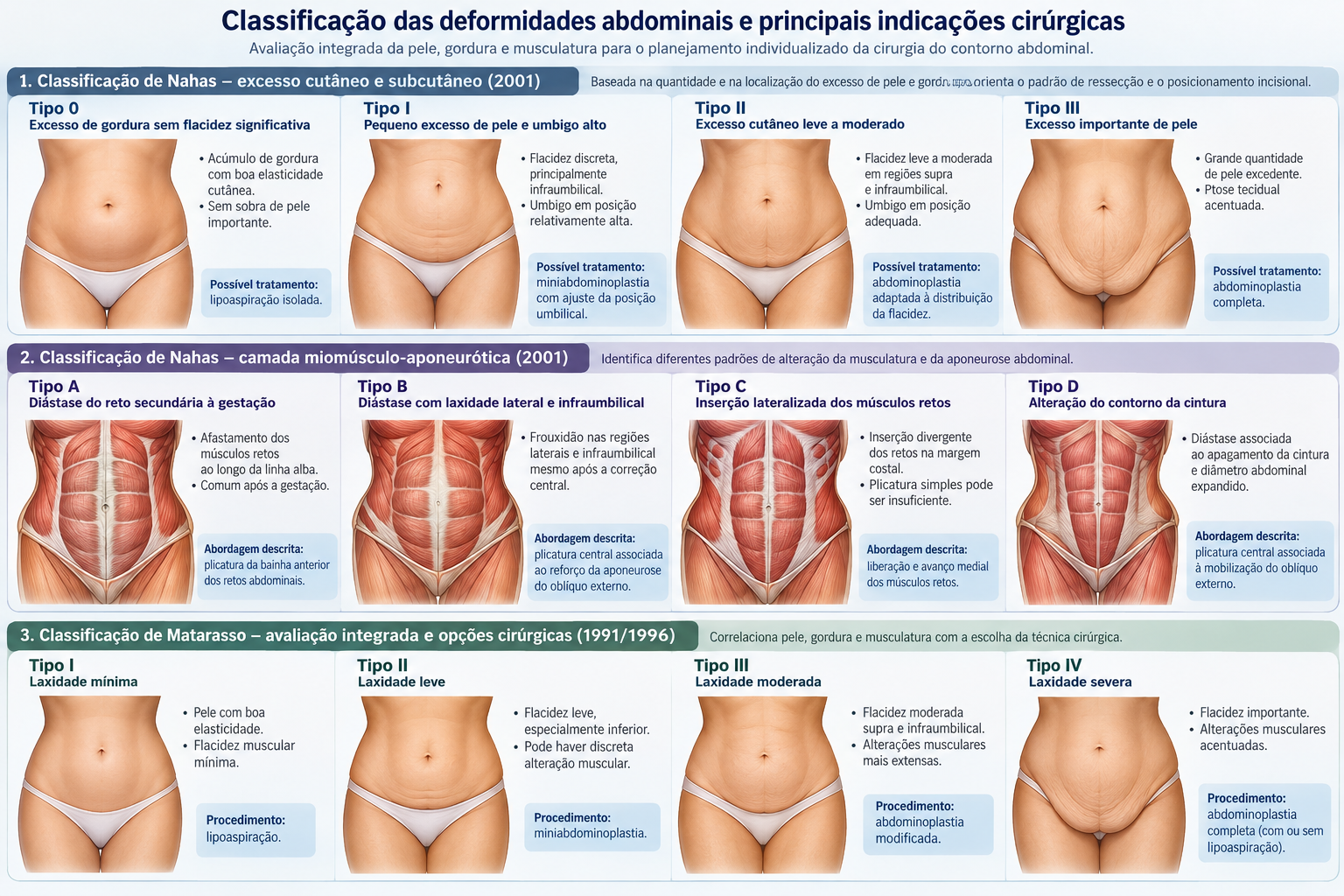
Nahas classification: skin and subcutaneous tissue
Nahas proposed a classification to organize cutaneous and subcutaneous excess:
- Type 0: predominance of localized fat, without significant skin redundancy. In selected patients, liposuction may be indicated.
- Type I: minimal skin excess, with a relatively high umbilicus. Limited resection techniques and umbilical adjustment may be considered.
- Type II: mild to moderate skin excess, with a distribution requiring adaptation of resection and undermining. The choice depends on flap mobility and vascularity.
- Type III: significant skin excess, frequently indicated for full abdominoplasty when clinical conditions permit.
This classification does not automatically determine the operation: elasticity, distribution of laxity, scars, and expectations also influence planning.
Nahas muscular classification
The same author described four patterns of musculoaponeurotic alterations, that is, of the abdominal muscles and their supporting fibrous structures.
Type A — Rectus abdominis diastasis
Diastasis is the widening of the linea alba with separation of the rectus muscles, frequently associated with pregnancy. In selected situations, it can be addressed with plication: sutures that bring the muscle sheath together.
Type B — Additional lateral and inferior laxity
In addition to central separation, laxity may exist in lateral or infraumbilical regions. Correction may require reinforcement of aponeurotic structures beyond the midline.
Type C — Lateralized insertion of the rectus muscles
A different anatomical arrangement of the superior insertions may render conventional central approximation insufficient. Specialized muscle advancement techniques have been described for specific cases.
Type D — Alterations in waist contour
Muscular and aponeurotic alterations can contribute to the loss of waist definition. Mobilization and reinforcement techniques of the lateral musculature have been described, but do not constitute mandatory management.
Matarasso: integrated evaluation
Matarasso's classification relates skin, fat, and the abdominal wall, guiding progressively more extensive procedures.
| Type | Predominant characteristics | Possible approach |
|---|---|---|
| I | Minimal skin and muscle laxity | Liposuction |
| II | Mild laxity, primarily lower abdomen | Miniabdominoplasty |
| III | Moderate laxity and more extensive muscle alterations | Modified abdominoplasty |
| IV | Severe laxity and muscle deformity | Full abdominoplasty, with or without liposuction |
These associations are guidelines, not universal prescriptions.
Bozola and Psillakis: a Brazilian contribution
In 1988, Bozola and Psillakis systematized the evaluation of abdominal deformities into five groups, taking into account skin, fat, and musculature. The central principle is to correct the structures that are actually altered, without unnecessarily extending the procedure.
Caldeira and the midi-abdominoplasty
Intermediate techniques, such as the midi-abdominoplasty, were proposed for specific patterns of flaccidity and to improve scar planning. They can be useful when a mini-abdominoplasty would be insufficient, but the distribution of excess skin does not require the same strategy as a conventional abdominoplasty.
Diastasis is not synonymous with hernia
Abdominal diastasis corresponds to the widening of the linea alba and separation of the rectus muscles, without necessarily having an opening in the abdominal wall. A hernia involves a defect in the wall through which tissues can protrude.
The European Hernia Society defines diastasis as a separation of the rectus muscles greater than 2 cm, but this measurement alone does not constitute an automatic indication for surgery. Symptoms, functional impact, the presence of an associated hernia, and conservative treatment options must be evaluated. Ultrasound and, in specific situations, computed tomography can be helpful.
How to choose the technique?
Liposuction: may be considered when localized fat predominates and the skin has sufficient elasticity to accommodate the volume reduction. It does not correct diastasis and does not remove significant excess skin.
Mini-abdominoplasty: considered when excess skin is more localized, typically below the umbilicus, with the possibility of limited resection.
Full abdominoplasty: considered in cases of more extensive flaccidity, frequently requiring umbilicus repositioning and potential correction of the muscular wall.
Modified techniques: may be necessary in patients with an unusual distribution of skin laxity, prior scars, or particular muscular deformities.
There is no fixed measurement of skin resection or body mass index that, on its own, defines the technique for all patients.
Safety and limitations
Preoperative planning must include an evaluation of overall health, weight stability, smoking status, associated diseases, previous surgeries, and thromboembolic risk. Prior scars can alter flap vascularization and require technical adaptations.
Risks include seroma (fluid accumulation), hematoma, infection, wound healing complications, sensory changes, skin vascular compromise, and thromboembolism. Association with liposuction requires careful attention to the extent of the procedure and vascular preservation. Body contouring surgery is not a substitute for the treatment of obesity.
Conclusion
The classifications by Nahas, Matarasso, and Bozola and Psillakis help in understanding distinct patterns of abdominal deformity. There is no single classification that determines the best surgery. The goal is to combine the evaluation of skin, fat, muscular anatomy, and risk factors for individualized, safe, and realistic planning.
References
- Bozola AR, Psillakis JM. Abdominoplasty: a new concept and classification for treatment. Plastic and Reconstructive Surgery. 1988;82(6):983–993.
- Matarasso A. Abdominolipoplasty: a system of classification and treatment for combined abdominoplasty and suction-assisted lipectomy. Aesthetic Plastic Surgery. 1991;15(2):111–121. https://doi.org/10.1007/BF02273843
- Nahas FX. A pragmatic way to treat abdominal deformities based on skin and subcutaneous excess. Aesthetic Plastic Surgery. 2001;25(5):365–371.
- Nahas FX. An aesthetic classification of the abdomen based on the myoaponeurotic layer. Plastic and Reconstructive Surgery. 2001;108(6):1787–1795.
- Hernández-Granados P, et al. European Hernia Society guidelines on management of rectus diastasis. British Journal of Surgery. 2021;108(10):1189–1191. https://doi.org/10.1093/bjs/znab128
Dr. Fernando Amato
Plastic Surgeon — CRM-SP 133826 | RQE 51573 and RQE 51436
https://plastico.pro
Illustrative image generated by artificial intelligence (image to be inserted manually before publication).
Agendar consulta
Precisa de orientação personalizada?
Marque uma avaliação com o Dr. Fernando Amato e tire as suas dúvidas sobre cirurgia plástica.
Falar no WhatsApp