
Post-laser exosomes have been discussed as a complementary strategy in dermatological and aesthetic procedures that cause controlled aggression to the skin, such as CO2 laser, fractional laser, intense pulsed light, and other technologies used for rejuvenation, texture improvement, blemishes, and scars.
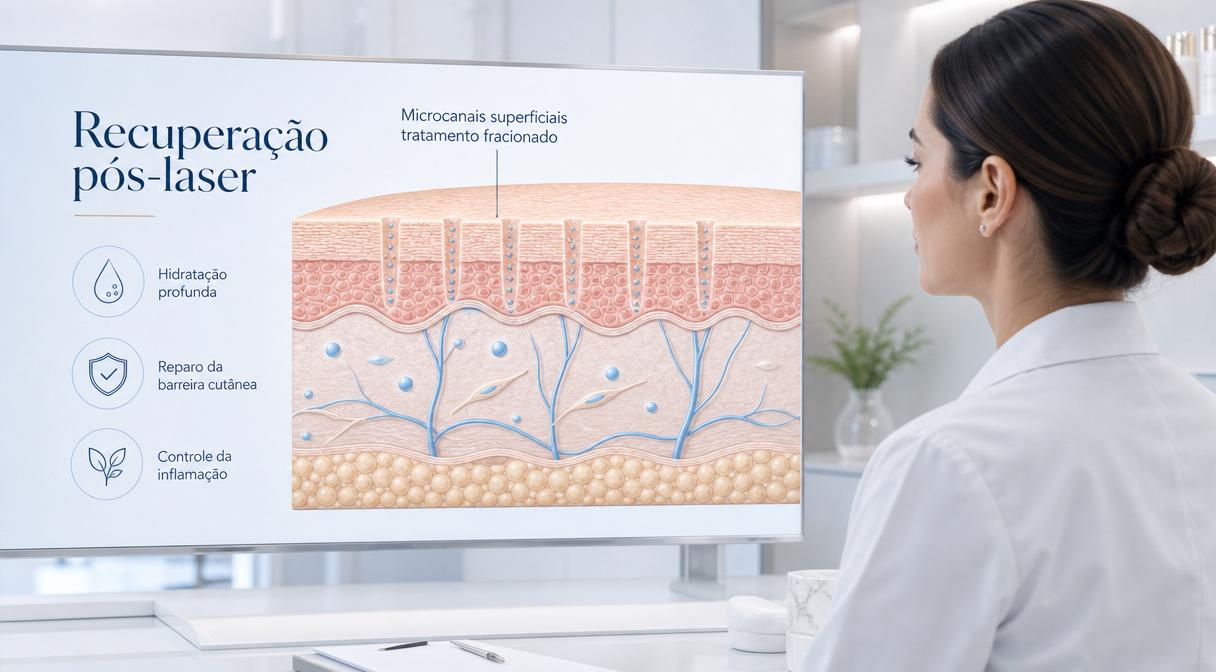
The proposal is to apply substances with regenerative potential immediately after the procedure, taking advantage of the moment when the skin barrier is temporarily more permeable. However, this does not mean that all products have the same effect, the same safety, or the same level of scientific evidence.
Exosomes are extracellular vesicles, small structures released by cells, that participate in communication between tissues. Recent scientific reviews indicate a growing interest in the use of these vesicles in dermatology, especially in wound healing, inflammation, pigmentation, and dermal matrix remodeling, but also reinforce the need for standardization, larger studies, and rigorous regulatory evaluation.
What are exosomes?
Exosomes are microscopic particles released by cells. They carry molecules such as proteins, lipids, and RNA fragments, functioning as biological messengers between one cell and another.
In aesthetic practice, the interest lies in the possible effect of these vesicles on processes such as inflammation, tissue repair, collagen formation, and pigmentary response. Collagen is a structural protein that helps maintain skin firmness and support.
It is important to differentiate scientific research from commercial promises. Although the topic is promising, exosomes applied in aesthetics still require careful evaluation regarding origin, processing, sterility, stability, dose, application method, and clinical indication.
Why apply post-laser exosomes?
Laser procedures work through controlled injury. Depending on the technology and parameters used, the laser can reach superficial or deeper layers of the skin, stimulating cell renewal, fiber contraction, and collagen reorganization.
After laser, especially in ablative procedures, redness, burning, edema, flaking, and the formation of small scabs may appear. These signs are part of the expected inflammatory process, but need to be well managed to reduce discomfort and the risk of complications.
The purpose of post-laser exosomes is to modulate this initial inflammatory environment, favoring more organized recovery. In theory, they could contribute to hydration, skin barrier repair, erythema control, and skin renewal.
Post-laser exosomes and the skin's permeability window
Immediately after certain procedures, the skin can temporarily become more permeable. In ablative lasers, such as some CO2 protocols, physical microchannels are formed that penetrate part of the epidermis.
In non-ablative treatments or with pulsed light, the skin barrier is not removed in the same way, but there may be a transient alteration in permeability due to heat, inflammation, and temporary changes in cell junctions.
This permeability window is one of the reasons why some protocols apply active ingredients immediately after laser. Still, greater penetration does not automatically mean greater safety. The more open the skin barrier is, the greater the need for sterility control, purity, and proper indication.
Ablative laser, non-ablative laser, and recovery
Ablative laser removes part of the skin's surface. Therefore, it tends to generate greater redness, scabbing, flaking, and recovery time, but can also offer more intense stimulation when well indicated.
Non-ablative laser heats layers of the skin without removing the surface so obviously. In general, it may have milder recovery, but the number of sessions and clinical response vary according to the objective.
There are also fractional technologies, which treat the skin in micro-zones, preserving surrounding areas to facilitate repair. The choice depends on the complaint, phototype, skin thickness, history of blemishes, and tolerance to recovery time.
Patients who have undergone or are planning facial rejuvenation procedures, such as blepharoplasty, should discuss with the surgeon whether complementary technologies, such as lasers, make sense in the overall plan.
Possible studied benefits
The main objectives attributed to post-laser exosomes are to reduce prolonged redness, accelerate skin barrier recovery, improve hydration, and favor the reorganization of treated tissue.
Some studies and clinical reports observe faster improvement of inflammatory signs when exosomes or extracellular vesicles are associated with procedures that stimulate the skin. However, research is still heterogeneous, with important differences between product origin, preparation method, concentration, application method, and evaluated outcomes.
Reviews on extracellular vesicles in wound healing indicate relevant biological potential, such as participation in inflammation, angiogenesis, and tissue remodeling. However, much of the scientific basis still involves preclinical studies, experimental models, or small clinical studies.
Therefore, it is more prudent to understand exosomes as a complementary resource under investigation and controlled use, not as a substitute for traditional post-laser care.
Limitations and points of attention
The first concern is product quality. Exosomes can have different origins, such as human, plant, animal, or derived from conditioned media. Each origin has distinct implications for composition, stability, compatibility, and regulation.
The second point is sterility. When applied to skin recently treated by laser, products come into contact with a weakened skin barrier. This requires greater rigor than expected for common cosmetics.
The third point is regulation. The FDA, the US regulatory agency, warns that exosome products marketed as regenerative medicine may not have approval for certain indications and should be evaluated with caution, especially when there are broad or unproven therapeutic claims.
In Brazil, the indication must comply with medical evaluation, applicable sanitary norms, and technical responsibility. The patient should ask about the product's origin, registration when applicable, purpose of use, possible risks, and alternatives.
Bovine-derived exosomes: what to consider
In some protocols, the use of freeze-dried bovine-derived exosomes associated with active ingredients such as hyaluronic acid, vitamins, peptides, and, in some formulations, tranexamic acid for pigmentary concerns was mentioned. Freeze-drying is a dehydration process that can help product stability, depending on the formulation and manufacturing control.
Hyaluronic acid acts as a moisturizer and can help reduce water loss on the skin surface. Peptides and vitamins are frequently used in cosmeceuticals with the aim of supporting the skin barrier and improving texture.
Tranexamic acid, on the other hand, is a substance studied for pigmentary disorders, especially melasma, due to its action on pigmentation-related pathways. Its topical use or association with procedures should be evaluated individually, especially in skin with a tendency to post-inflammatory hyperpigmentation.
For products of animal origin, it is also reasonable to discuss allergies, traceability, purification, and safety. Patients with relevant allergies should inform their doctor before any application.
High phototypes and risk of hyperpigmentation
Higher phototypes are skin that tans more easily and has a greater amount of melanin. In these patients, inflammatory procedures can increase the risk of post-inflammatory hyperpigmentation, which is the darkening of the skin after irritation, acne, burns, laser, or surgery.
This does not mean that lasers are prohibited in these cases. It means that the choice of technology, energy, interval between sessions, skin preparation, and subsequent care need to be more rigorous.
Inflammation control is an important part of this planning. Sunscreen, adequate hydration, avoiding sun exposure, and following the medical protocol are essential measures.
Before any procedure, it is worth reviewing general guidelines on pre-operative tips, as inadequate preparation can increase avoidable risks.
Care that remains indispensable
Even when advanced technologies are used, the fundamentals of recovery remain important. The skin needs adequate cleansing, hydration, sun protection, infection control when necessary, and medical follow-up.
Smoking deserves special attention. Smoking harms tissue oxygenation, interferes with microcirculation, and can compromise healing. In aesthetic procedures, this can increase the risk of slower recovery and complications. Learn more about smoking risks.
Diet also influences recovery. Adequate intake of proteins, vitamins, minerals, and hydration helps the body support tissue repair. General guidelines on diet can be useful, but do not replace nutritional evaluation when there are diseases, restrictions, or major surgeries.
In addition, the patient should avoid manipulating scabs, using acids on their own, applying unprescribed products, and exposing themselves to the sun without medical clearance.
Who can benefit from the association?
The association between laser and exosomes can be considered in contexts such as facial rejuvenation, texture improvement, selected scars, pores, blemishes, and recovery from more intense procedures.
The indication depends on skin type, history of keloid or hypertrophic scar, tendency to blemishes, dermatological diseases, use of medications, history of herpes, pregnancy, immunosuppression, and patient expectations.
Patients who only desire a slight improvement in radiance may benefit more from a consistent dermatological routine and less aggressive procedures. On the other hand, people with deeper changes may need a combined plan, with stages and realistic expectations.
No topical product should be presented as a guarantee of results. The benefit, when it occurs, depends on correct indication, technique, individual response, and subsequent care.
Important questions before the procedure
- What is the objective of the laser in my case?
- Will the product be applied to intact skin or immediately after aggression to the skin barrier?
- What is the origin of the exosomes?
- Is there sterility control and individual use?
- What are the risks of allergy, irritation, or infection?
- Is there a simpler alternative for my case?
- What should I avoid before and after the procedure?
- How will follow-up be if there is persistent redness, blisters, pain, or blemishes?
These questions help transform an aesthetic trend into a more conscious medical decision.
Post-laser exosomes: caution, science, and individualization
Post-laser exosomes represent an interesting area of regenerative medicine applied to the skin. The biological rationale is plausible: modulate inflammation, cell communication, and tissue repair after controlled aggression.
On the other hand, there are still important gaps. Studies vary greatly in methodology, products are not equivalent to each other, and regulation may differ according to country, composition, and claimed purpose.
It is safest to treat this approach as a potential complement, not as a universal solution. The result of a laser depends mainly on correct indication, technical execution, skin preparation, parameters used, phototype, patient habits, and adequate follow-up.
When well indicated and performed by a qualified professional, laser can be a valuable tool in rejuvenation and improving skin quality. The association with regenerative active ingredients should be discussed transparently, without promises, and always within an individualized plan.
FAQ
Do post-laser exosomes make the skin heal faster?
They may have the potential to modulate the inflammatory response and promote recovery, but this should not be understood as a guarantee. The speed of healing depends on the type of laser, treatment depth, patient health, and subsequent care.
Does every patient who undergoes laser treatment need to use exosomes?
No. Many patients recover well with conventional care, such as cleansing, hydration, sun protection, and prescribed ointments. The indication of exosomes should be individualized and justified by the treatment objective.
Do exosomes replace sunscreen and post-laser care?
No. Sunscreen, avoiding sun exposure, hydration, and medical follow-up remain fundamental measures. No regenerative active ingredient compensates for poorly managed post-procedure care.
Is there a risk of allergy?
There is a possibility of irritation, allergy, or unexpected reaction, as occurs with various products applied to the skin, especially after procedures. In patients with a significant allergic history, the doctor may consider additional precautions, testing in a small area, or choosing an alternative.
Can exosomes be used for blemishes?
Some formulations are studied to help control inflammation and pigmentation, especially when combined with substances like tranexamic acid. However, blemishes have varied causes and can worsen if the laser is poorly indicated or if there is inadequate sun exposure.
What is the difference between exosomes and hyaluronic acid?
Exosomes are extracellular vesicles involved in cell communication. Hyaluronic acid is a molecule with a high capacity to attract water, used for hydration and, in other forms, filling. In some topical products, the two can appear combined, but they have different functions.
How long does redness last after laser?
It depends on the type of laser, the energy used, the treated area, and the patient's skin. More superficial lasers tend to have shorter recovery, while deep ablative treatments can generate redness and flaking for longer. The doctor should inform the expected interval for the chosen protocol.
Agendar consulta
Precisa de orientação personalizada?
Marque uma avaliação com o Dr. Fernando Amato e tire as suas dúvidas sobre cirurgia plástica.
Falar no WhatsApp